QuoteDone · CIS Tax Guides
Your CIS deduction statement is the single document that proves how much tax your contractor sent to HMRC on your behalf. Without it, you can't claim your refund, you can't verify your deductions, and you can't prove your income. Here's how to read it, what to check, and what to do if you're not getting one.
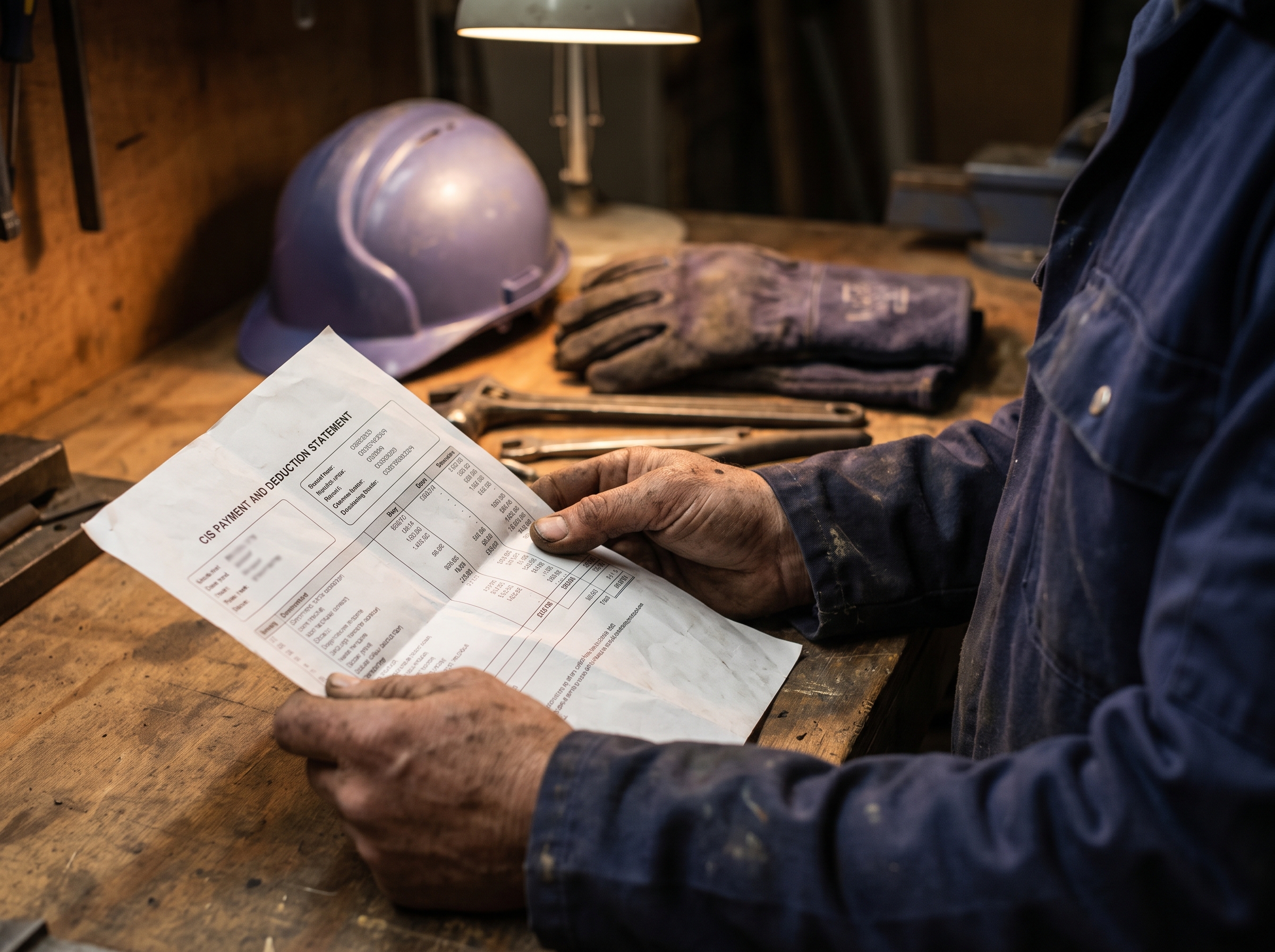
Every time a contractor pays you under the Construction Industry Scheme, they're required to give you a document. Not an invoice — that's what you send to them. This is what they send back: a CIS payment and deduction statement.
It's the subcontractor's equivalent of a payslip. It confirms how much you were paid, how much was deducted for tax, and how much the contractor sent to HMRC on your behalf. It's also the single most important document you need when it comes to claiming your CIS refund — and the one that subcontractors most commonly lose, ignore, or never receive in the first place.
"No deduction statement means no proof of tax paid. No proof of tax paid means no refund. It's that simple — and that expensive to get wrong."
— QuoteDone CIS Tax GuidesWhat's on a CIS Payment and Deduction Statement?
The statement is a straightforward document, but every line on it matters. Here's what it contains:
CIS Statement — Line by Line
The critical number is the CIS deduction amount. This is the tax that was taken from your payment and sent to HMRC. At the end of the tax year, you add up all the CIS deductions from all your statements and enter the total on your Self Assessment. If the total deductions exceed your actual tax liability — which they usually do — HMRC refunds the difference.
Statement vs Invoice — They're Not the Same Thing
This is a common point of confusion. An invoice and a deduction statement are two different documents that flow in opposite directions:
Your Invoice
- You create it and send it to the contractor
- Requests payment for work completed
- Shows labour, materials, and total due
- Sent before payment is made
- Your document — you control the content
CIS Deduction Statement
- The contractor creates it and gives it to you
- Confirms what was paid and what was deducted
- Shows gross, materials, deduction, and net
- Issued after payment is made
- Their document — they're legally required to provide it
You need both. The invoice is your record of what you billed. The statement is your proof of what was deducted. When you file your Self Assessment, it's the statement — not the invoice — that supports your refund claim.
Why Every Statement Matters for Your Refund
When you file your Self Assessment, there's a specific box on the self-employment pages (SA103S or SA103F) where you enter your total CIS deductions for the year. That number comes directly from your payment and deduction statements — you add them up, enter the total, and HMRC offsets it against your tax bill.
If you're missing a statement, you're missing a deduction. A missing deduction means a smaller refund — or worse, paying tax you've already paid.
What a Missing Statement Costs You — Example
That's £800 you've already paid to HMRC through your contractor — money that's gone from your earnings. Without the statement to prove it, you can't claim it back. Multiply that across several missing statements or several years of not keeping them, and the numbers get serious quickly.
✓ No registration required · 100% Free · HMRC 2026/27 Aligned
When Should You Receive Your Statement?
Contractors must issue your CIS payment and deduction statement within 14 days of the end of each tax month. HMRC tax months run from the 6th of one month to the 5th of the next — so a payment made on 20 July falls in the tax month ending 5 August, and your statement should arrive by 19 August.
In practice, many contractors issue statements with each payment or at the end of each calendar month. From April 2026, HMRC encourages contractors to issue statements electronically where possible — by email or through payroll software — rather than on paper.
What to Do If You're Not Getting Statements
- Ask your contractor directly — in writing (email or text). Most of the time, statements are simply overlooked, not deliberately withheld. A direct request usually resolves it.
- Check if they're being sent electronically — some contractors email statements or make them available through payroll software portals. Ask if this is the case and where to access them.
- Contact HMRC's CIS helpline — call 0300 200 3210 (Monday to Friday, 8am to 6pm). HMRC can check what the contractor has reported on their CIS monthly returns and may be able to reconstruct your deduction records from their data.
- If the contractor has ceased trading — contact HMRC in writing with the contractor's details, the dates you worked, the payment amounts, and your bank statement evidence. HMRC can attempt to reconstruct records from the contractor's filed CIS returns.
How to Check Your Statement Is Correct
Mistakes happen. Contractors sometimes apply the wrong deduction rate, miscalculate materials, or report incorrect figures to HMRC. Here's what to verify on every statement:
- Your name and UTR are correct — if these don't match HMRC's records, the deductions won't be linked to your tax account
- The deduction rate is right — 20% if you're registered, 30% if not. If you're registered but being deducted at 30%, your contractor hasn't verified you properly
- Materials are separated from labour — CIS deductions apply only to the labour portion. If materials aren't broken out, you're being over-deducted
- The gross amount matches your invoice — what the contractor says they paid you should match what you billed and what landed in your bank (minus the deduction)
- The net payment matches your bank statement — cross-reference the net figure on the statement with the actual deposit in your account
How Long to Keep Your Statements
HMRC requires you to keep business records for at least 5 years after the 31 January filing deadline for the relevant tax year. Since you can claim CIS refunds up to 4 years back, keeping statements for at least 6 years is the safest approach.
Paper statements get lost — especially on construction sites. The simplest solution is to take a photo or scan of every statement the moment you receive it and save it in a dedicated folder (phone, email, cloud drive). Digital copies are accepted by HMRC as valid records.
Statements and Your SA302
Your CIS deduction statements feed directly into your Self Assessment, and your Self Assessment generates your SA302 — the HMRC document that proves your income to mortgage lenders, banks, and visa officers. The chain is straightforward: accurate statements lead to an accurate return, which leads to an accurate SA302, which leads to a smooth mortgage application.
If your statements are missing or incorrect, the numbers on your SA302 won't reflect what you actually earned and paid — and that causes problems downstream.
Your CIS Statement Checklist
- Request statements from every contractor you work for — don't assume they'll send them
- Check each statement when you receive it — verify name, UTR, rate, materials, and amounts
- Photograph or scan every statement immediately and save it digitally
- Cross-reference net payments against your bank statements monthly
- Add up total deductions at tax year end (6 April to 5 April)
- Enter the total in the CIS deductions box on your Self Assessment (SA103S/SA103F)
- Keep all statements for at least 6 years
- If any are missing, contact the contractor or HMRC before you file
Frequently Asked Questions
Is a CIS statement the same as a payslip?
Functionally, yes — it's the CIS equivalent of a PAYE payslip. It shows your gross pay, what was deducted for tax, and your net pay. The difference is that a payslip comes from an employer, while a CIS statement comes from a contractor — reflecting the self-employed nature of CIS subcontracting.
Can I get a CIS statement from HMRC directly?
HMRC doesn't issue CIS payment and deduction statements — that's the contractor's responsibility. However, if your contractor hasn't provided one, HMRC can check what the contractor reported on their monthly CIS returns and share that information with you. Call the CIS helpline on 0300 200 3210.
What if the deduction rate on my statement is wrong?
If you're registered for CIS but your statement shows 30% instead of 20%, your contractor hasn't verified you correctly with HMRC. Contact them immediately and ask them to re-verify your details. Give them your UTR and National Insurance number so they can check your status through HMRC's system. Going forward, they should deduct at 20%.
Do I need statements if I use an accountant?
Yes. Your accountant needs the same information to prepare your Self Assessment. They can't file accurate CIS deductions without the statements. Collect them yourself and hand them over — don't assume your accountant can get them from HMRC or from the contractor directly.
People Also Ask
What is a CIS payment and deduction statement?
A CIS payment and deduction statement is a document that contractors must give to subcontractors for every CIS payment. It shows the gross payment, the cost of materials (not subject to deduction), the CIS deduction amount, and the net payment. It must be issued within 14 days of the end of each tax month. It's the subcontractor's proof of tax paid.
Do I need CIS statements to claim a tax refund?
Yes. Your CIS payment and deduction statements are the evidence of how much tax was deducted during the year. You need the total from all your statements to complete the CIS deductions box on your Self Assessment. Without them, you can't prove how much was deducted, and HMRC may not process your refund.
What do I do if my contractor won't give me a CIS statement?
Ask in writing first — email or text. If they still don't provide one, contact HMRC's CIS helpline on 0300 200 3210. HMRC can check what the contractor reported on their monthly CIS returns and may be able to reconstruct your records. Contractors who fail to issue statements are in breach of CIS regulations.
How long should I keep CIS deduction statements?
Keep them for at least 6 years. HMRC requires business records to be kept for 5 years after the filing deadline, and since you can claim CIS refunds up to 4 years back, 6 years covers both. Photograph or scan them immediately — digital copies are accepted by HMRC.
QuoteDone Tools
Got Your Statements? Now Check Your Refund.
Add up your CIS deductions and see what HMRC owes you — then make sure every future invoice separates labour and materials correctly.
This article is for informational purposes only and does not constitute formal tax, financial, or legal advice. CIS regulations, deadlines, and requirements are subject to change. Always consult a qualified accountant if you're unsure about your tax position. Aligned to 2026/27 HMRC guidance.