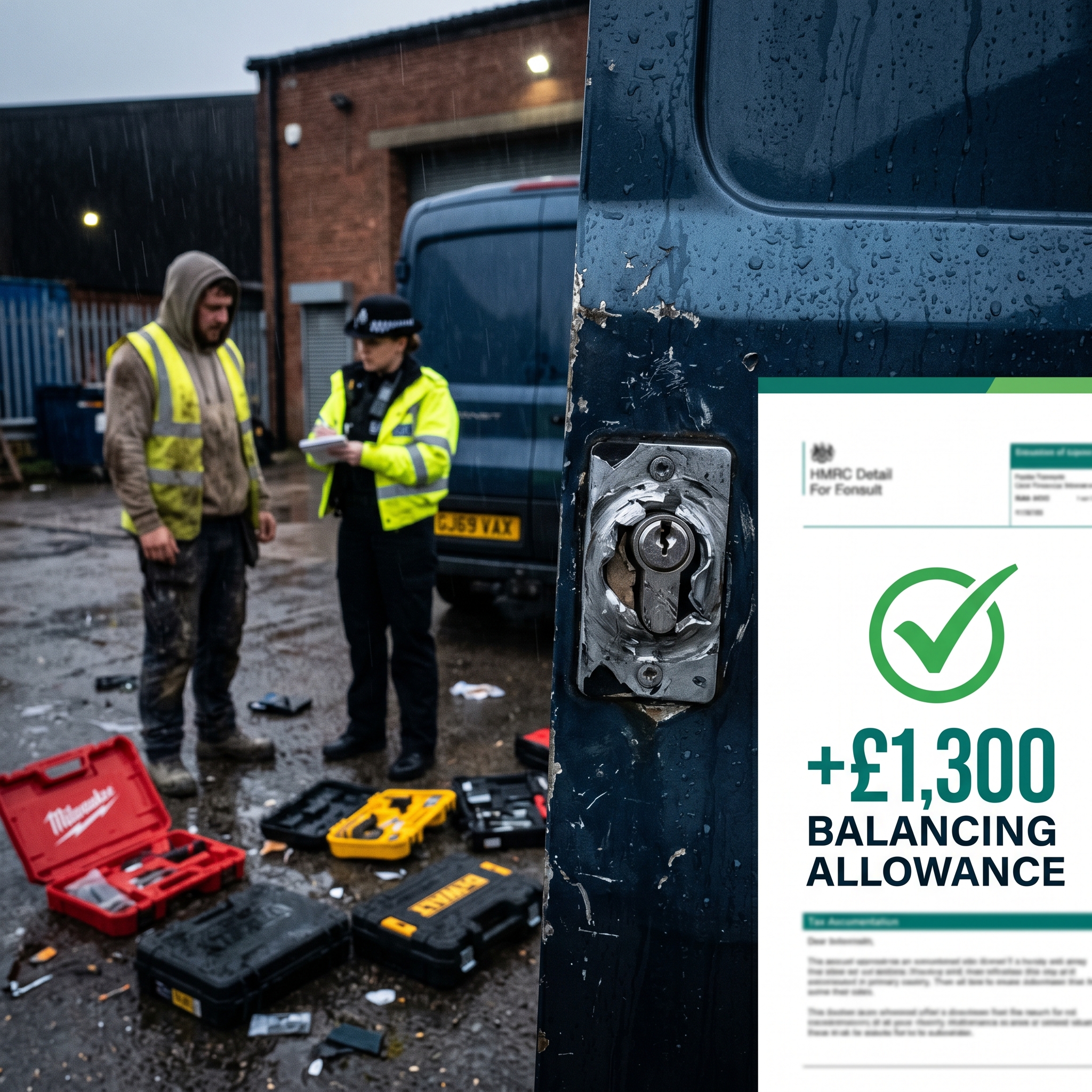
Tool theft costs you twice — once when it happens, and again if you handle the tax incorrectly. Most subcontractors replace their tools and move on. The ones who don't know about balancing allowances quietly overpay tax on top of everything else.
You come back to the van on Monday morning. The lock's been forced, the drawers are empty, and £3,000 worth of tools you bought over the past two years are gone. You file the police report, call the insurer, and start pricing up replacements.
Most tradespeople stop there. Buy the new kit, claim it under AIA, and carry on. But there's a step in the middle that most people miss — and missing it means leaving a tax relief on the table that HMRC never volunteers to tell you about.
When your tools are stolen, HMRC treats the theft as a disposal of the asset. How you handle that disposal in your accounts — and what your insurer pays versus what the tools were worth on paper — determines whether you get extra tax relief or face an unexpected tax charge. The difference can run to hundreds of pounds either way.
The Balancing Allowance Calculation
Example: tools stolen from site van · insurance payout below written-down value
How Capital Allowances Work When Tools Are Stolen
When you buy tools, HMRC allows you to deduct the cost from your taxable profit — either through the 100% Annual Investment Allowance (AIA) in the year of purchase, or by adding them to the 18% capital allowances pool to be written down gradually over time.
When those tools are stolen, the asset is removed from the pool. If your insurer pays you something for them, that payment is treated as disposal proceeds and goes back into the pool as income. The difference between what's left in the pool and what the insurer pays produces either:
Insurance pays less than written-down value
The unrecovered difference is treated as an additional deduction against your taxable profit in the year of disposal. The more the insurer falls short of the tool's book value, the larger the relief you can claim.
Insurance pays more than written-down value
If you claimed full AIA in year one and the insurer pays out the full replacement value, the payout exceeds the remaining pool balance. The excess is added back to your taxable profit. This catches subcontractors who claimed the tools fully in year one and then received a generous settlement.
The Numbers: A Real Scenario
James bought a set of trade tools two years ago for £4,500, claiming them through the 18% main pool. Their current written-down value is £2,800. The tools are stolen from his van overnight. His insurer settles at £1,500.
| Written-down value in pool at time of theft | £2,800 |
| Insurance payout (disposal proceeds) | −£1,500 |
| Balancing allowance claimable | £1,300 |
James claims the £1,300 balancing allowance in his Self Assessment, reducing his taxable profit by that amount.
- At basic rate (20%): £260 tax saved
- At higher rate (42%): £546 tax saved
He then buys replacement tools at £3,200 and claims 100% AIA on the full amount in the same tax year — a further £3,200 deduction from taxable profit. The theft and replacement together reduce his bill by £4,500 in deductions, not just the replacement cost alone.
If you claimed 100% AIA on your tools in year one, the written-down value in your pool may be zero. In that case, any insurance payout is pure income — it goes straight back into your pool as a taxable receipt, and you will face a balancing charge on the full settlement amount.
Example: tools claimed at £4,500 AIA in year one. Pool value: £0. Insurer pays £2,000. That £2,000 is a balancing charge — it increases your taxable profit by £2,000 in the year of the theft. At 20%, that's £400 of unexpected tax on top of the theft itself. At 42%, it's £840.
This is the most common tax surprise after tool theft — and it only hits people who claimed AIA correctly on purchase.
The One Document You Must Have
Everything in your tax treatment depends on one thing you have to get on the day of the theft: a Crime Reference Number (CRN) from the police. Without it, HMRC will not accept the disposal. You cannot claim the balancing allowance. The theft, for tax purposes, never happened.
Call 101 the same day, report the theft, and get the reference number in writing. If you report it online, save the confirmation email. This is the single most time-sensitive action on the entire checklist — everything else can wait until you've spoken to your accountant, but the police report cannot.
If the stolen items were individually worth less than £500, they were likely claimed as revenue expenses rather than through capital allowances. In that case, the disposal treatment above doesn't apply — replacement tools under £500 are simply expensed in the year of purchase with no pool adjustment needed. Your accountant can confirm which treatment applies to each item on your inventory.
What to Do — in the Right Order
Call 101 or report online at gov.uk. Get your Crime Reference Number in writing and save it. Without this, the disposal cannot be processed for tax purposes and all further steps are blocked. Do not wait until the next day or until you've spoken to your insurer.
List every stolen item with the original purchase date, approximate cost, and where you bought it. Pull any receipts you have — phone photos, email confirmations, bank statements. The more detail you can provide, the stronger your insurance claim and the more accurately your accountant can calculate the disposal value for capital allowances.
Keep the final settlement letter from your insurer — not just the payment. The exact figure is your disposal proceeds for the capital allowances calculation. Any excess you paid out of pocket (above the settlement) is the uninsured loss and may form part of your balancing allowance claim.
You need to know the current value of the stolen assets in your capital allowances pool. Your accountant holds this figure. With the written-down value and the insurance payout, they can calculate whether you're entitled to a balancing allowance or face a balancing charge — and ensure it's reflected correctly in your Self Assessment before it's submitted.
New tools purchased to replace stolen ones qualify for 100% Annual Investment Allowance in the year of purchase — the same year you're processing the disposal. Timing the replacement buy before your year-end allows both the balancing allowance on the old tools and the AIA on the new ones to reduce your profit in the same return, maximising the tax impact in the hardest year.
Had tools stolen recently?
The tax treatment of the disposal needs to be handled before your next Self Assessment is filed — not after. If you're not sure what's sitting in your capital allowances pool or whether you face a balancing allowance or charge, a quick review now prevents a costly mistake later.
Book a Capital Allowances Review →Frequently Asked Questions
Tool theft · capital allowances · CIS subcontractors · 2026
Can I claim tax relief if my tools are stolen?
Yes. When tools are stolen, HMRC treats the theft as a disposal of the asset. If the insurance payout is less than the written-down value of the tools in your capital allowances pool, you can claim a balancing allowance — an additional deduction from your taxable profit equal to the difference. You will also need a Crime Reference Number from the police to support the disposal. New replacement tools can then be claimed under the Annual Investment Allowance (AIA) in the same tax year.
What is a balancing allowance and how is it calculated?
A balancing allowance is an additional capital allowance given when an asset is disposed of for less than its written-down value in your tax pool. For stolen tools, it is calculated as: written-down value minus insurance payout = balancing allowance. For example, if tools have a written-down value of £2,800 and the insurer pays £1,500, the balancing allowance is £1,300 — reducing your taxable profit by that amount. At 20% basic rate this saves £260 in tax; at the 42% combined higher rate, £546.
What is a balancing charge and when does it apply?
A balancing charge is the opposite of a balancing allowance. It occurs when the insurance payout exceeds the written-down value of the tools in your pool — most commonly when you claimed 100% Annual Investment Allowance in the year of purchase (leaving the pool at zero) and then received a meaningful insurance settlement. The excess payout is treated as additional taxable income in the year of disposal. This is the most common tax surprise after tool theft for subcontractors who correctly claimed AIA on purchase.
Do I need a police report to claim tax relief on stolen tools?
Yes. A Crime Reference Number (CRN) from the police is required to process the disposal in your capital allowances records. HMRC will ask for it during any compliance check. Without it, you cannot substantiate that the tools were stolen rather than sold or disposed of in another way, and the balancing allowance claim will not stand. Report the theft on the day it occurs — call 101 or report online at gov.uk — and keep the confirmation with your tax records.
Can I claim for tools stolen from my van or site?
Yes — the location of the theft does not affect the tax treatment. Tools stolen from a van, a site storage area, or your home workshop are all treated the same way for capital allowances purposes, provided the tools were used exclusively for your trade and were included in your capital allowances pool (or previously expensed as revenue items). Note that insurance cover may vary depending on whether your policy covers tools in transit, on site, or in a specific type of vehicle — check the terms before assuming you're covered at the point of claim.