Vehicle Tax · 2026/27
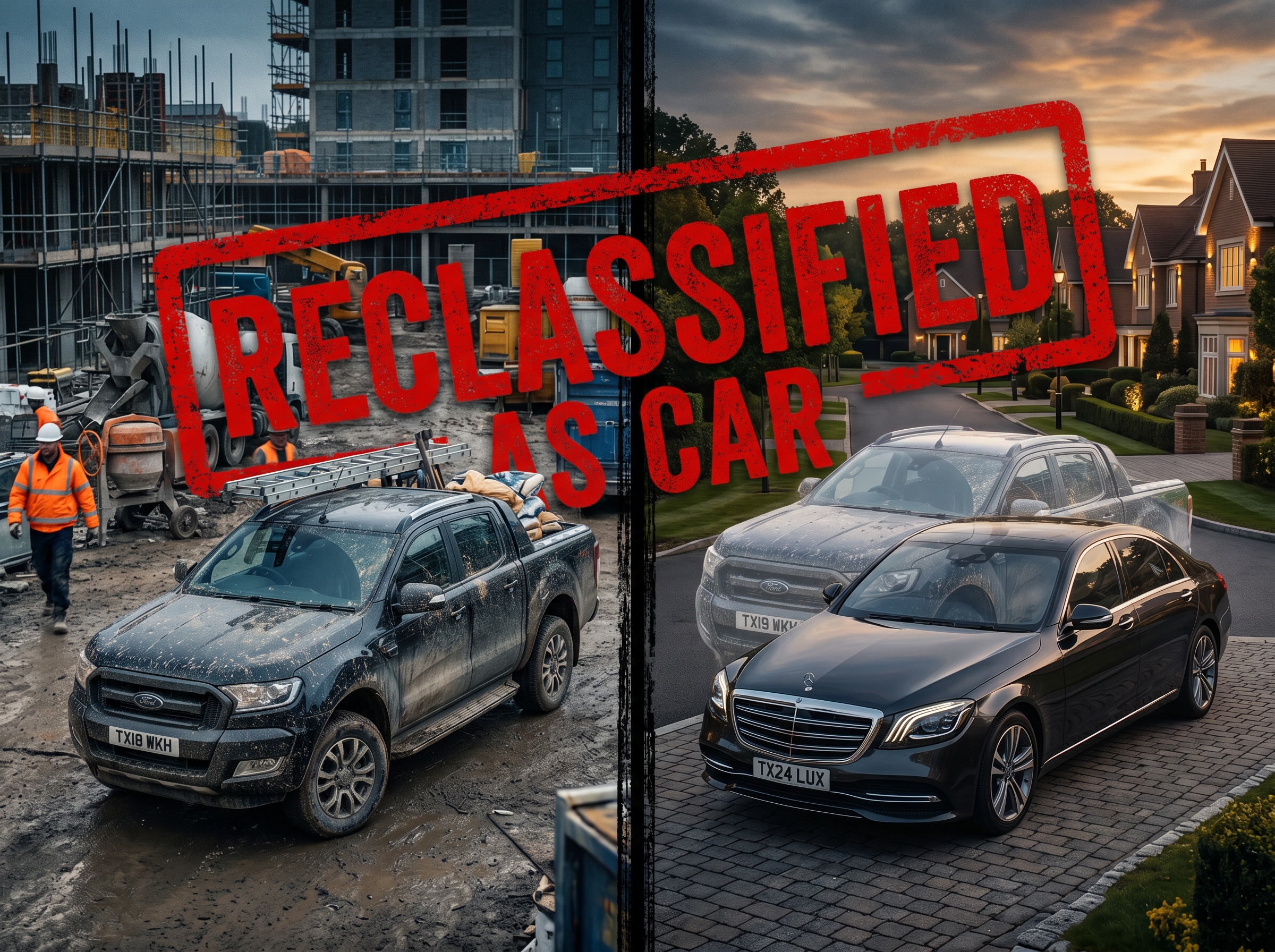
It has a load bed. It looks like a van. So HMRC treats it like one — right? Since April 2025, that assumption can cost a CIS subcontractor £3,500+ a year. Here's what changed, and how to avoid the trap.
For years, the rule was simple: a double-cab pickup with a one-tonne payload was a van for tax purposes. Many subcontractors bought their Hilux or Ranger on exactly that basis. Then, in April 2025, HMRC changed the rules — and a lot of those vehicles quietly became cars in the eyes of the taxman, with all the cost that brings.
The Assumption That Costs Subcontractors Thousands
Ask most tradespeople why they bought a double-cab pickup and you'll hear some version of: "It's a van, so it's tax-efficient — full write-off, low Benefit in Kind, reclaim the VAT." For years, that logic held. The vehicle had a load bed, a one-tonne payload, and HMRC treated it as a commercial vehicle.
That logic is now out of date. The rules changed, and the change was significant enough that a vehicle which was a "van" in March 2025 may be a "car" if purchased after April 2025 — with a tax bill that can differ by thousands of pounds a year.
The vehicle did not change. The load bed is still there. What changed is how HMRC classifies it — and that single reclassification can cost more than the fuel for the year.
CIS Tax Insights, 2026The Big Rule Change: What Happened in April 2025
The One-Tonne Payload Test No Longer Decides BIK or Capital Allowances
Until 6 April 2025, the key test for a double-cab pickup was payload: 1,000kg or more meant it was treated as a van. From 6 April 2025, HMRC changed its approach. Most double-cab, king-cab and extended-cab pickups are now treated as cars for Benefit in Kind and capital allowances purposes — because HMRC considers them equally suited to carrying passengers as goods. The payload figure still matters for VAT, but it no longer determines the BIK or capital allowances position.
Vehicles purchased, leased, or ordered before 6 April 2025 may benefit from transitional arrangements that preserve the old treatment for a limited period. If you bought your pickup before that date, do not assume the new rules automatically apply to you — but do not assume they don't, either. This is exactly the kind of detail to confirm in writing with your accountant.
Van vs Car: What the Classification Actually Means for Your Money
The difference is not academic. It affects three separate things — Benefit in Kind, capital allowances, and VAT — and the gap between them is where the thousands of pounds disappear.
| If van: year-one capital relief (AIA) | Up to £42,000 |
| If van: annual BIK (flat rate) | ~£4,170 |
| If van: VAT reclaim potential | ~£7,000 |
| If car: year-one capital relief (18% WDA) | ~£7,560 |
| If car: annual BIK (list price × CO₂ band) | ~£12,000–£15,000 over a few years |
| If car: VAT reclaim | Usually £0 |
| Approximate annual cost difference | £3,500+ |
These are illustrative figures — the exact numbers depend on the vehicle's list price, CO₂ emissions, your tax rate, and your business use percentage. But the direction is consistent: a car-classified pickup costs a CIS subcontractor materially more, every year they hold it.
Practical Checklist Before You Buy or Lease
-
Get the Exact Classification in Writing — Not the Dealer's Word Showroom staff are selling vehicles, not giving tax advice. "It's classed as a van, mate" is not a defence if HMRC disagrees. Get written confirmation of how the specific model — ideally tied to the exact specification or VIN — will be treated for BIK and capital allowances. If the dealer can't provide it, your accountant can confirm before you commit.
-
Remember Payload Still Matters — But Only for VAT The old one-tonne payload rule has not disappeared entirely. It still applies for VAT reclaim purposes. What changed is that it no longer determines the BIK or capital allowances treatment. So a vehicle can simultaneously qualify for VAT reclaim (payload over one tonne) and be treated as a car for BIK. Do not assume the two move together — they no longer do.
-
Avoid Modifications That Push It Toward "Car" Added rear seating, luxury interior trim, certain hard-top canopies and conversions can all strengthen HMRC's view that the vehicle is equally suited to carrying passengers — which is the test that now lands a pickup in the car category. If tax efficiency is a priority, a more utilitarian specification is the safer choice.
-
Keep Detailed Mileage and Business-Use Records If the vehicle is treated as a car, the BIK charge — and any private-use adjustment — depends heavily on how it is used. A clear, contemporaneous mileage log separating business from private journeys is essential, both to calculate the charge correctly and to defend your position if HMRC queries it. Reconstructing this after the fact is far weaker evidence.
-
Run the Full Numbers Before Signing — Not After Before you buy or lease, ask your accountant to model the total cost under both scenarios: BIK, capital allowances, and VAT combined. The headline price of the vehicle is often the smallest part of the decision. A £42,000 pickup that's a car can cost considerably more over three years than a £42,000 panel van that's a van — and that calculation should happen before the order is placed.
Pickup or Panel Van? The Honest Decision Framework
- You need rear passenger seats for crew or workers
- You need genuine off-road capability for site access
- You need significant towing capacity
- You accept the higher tax cost as the price of capability
- You have modelled the full cost and it still makes sense for your work
- Maximum capital allowances (full AIA) matter to you
- You want a low, flat, predictable BIK charge
- You want reliable VAT reclaim on purchase
- You don't genuinely need passenger seating or off-road ability
- You want the safest position if HMRC reviews your return
Don't Let "It's a Van" Be a £10,000 Mistake
The single most expensive sentence in this entire area is: "It's got a load bed, so it's a van." Until April 2025, that was often true. Now, for most double-cab pickups, it is not — and the gap between assuming and confirming can run to several thousand pounds a year.
Before you buy or lease your next vehicle, do two things. Get the exact HMRC classification for that specific vehicle in writing. Then ask your accountant to model the total tax cost — BIK, capital allowances, and VAT together — under both treatments.
A vehicle is a multi-year commitment. A few hours of checking before you sign protects you from a tax cost that compounds every year you own it. In 2026, "I assumed it was a van" is one of the most expensive assumptions a subcontractor can make.
QuoteDone Tools
Make Sure Every Claim Is Working For You.
Your vehicle is one of your biggest costs — make sure your CIS position and invoicing are capturing everything you're entitled to.
This article is for informational purposes only and does not constitute professional tax or financial advice. Vehicle tax classification is complex and fact-specific — always confirm the treatment of a specific vehicle with a qualified accountant before purchase or lease. Figures are illustrative estimates based on 2026/27 HMRC thresholds.