Self Assessment · 2026/27
The CIS Tax Refund: How to Avoid Costly Mistakes That Delay Your Money
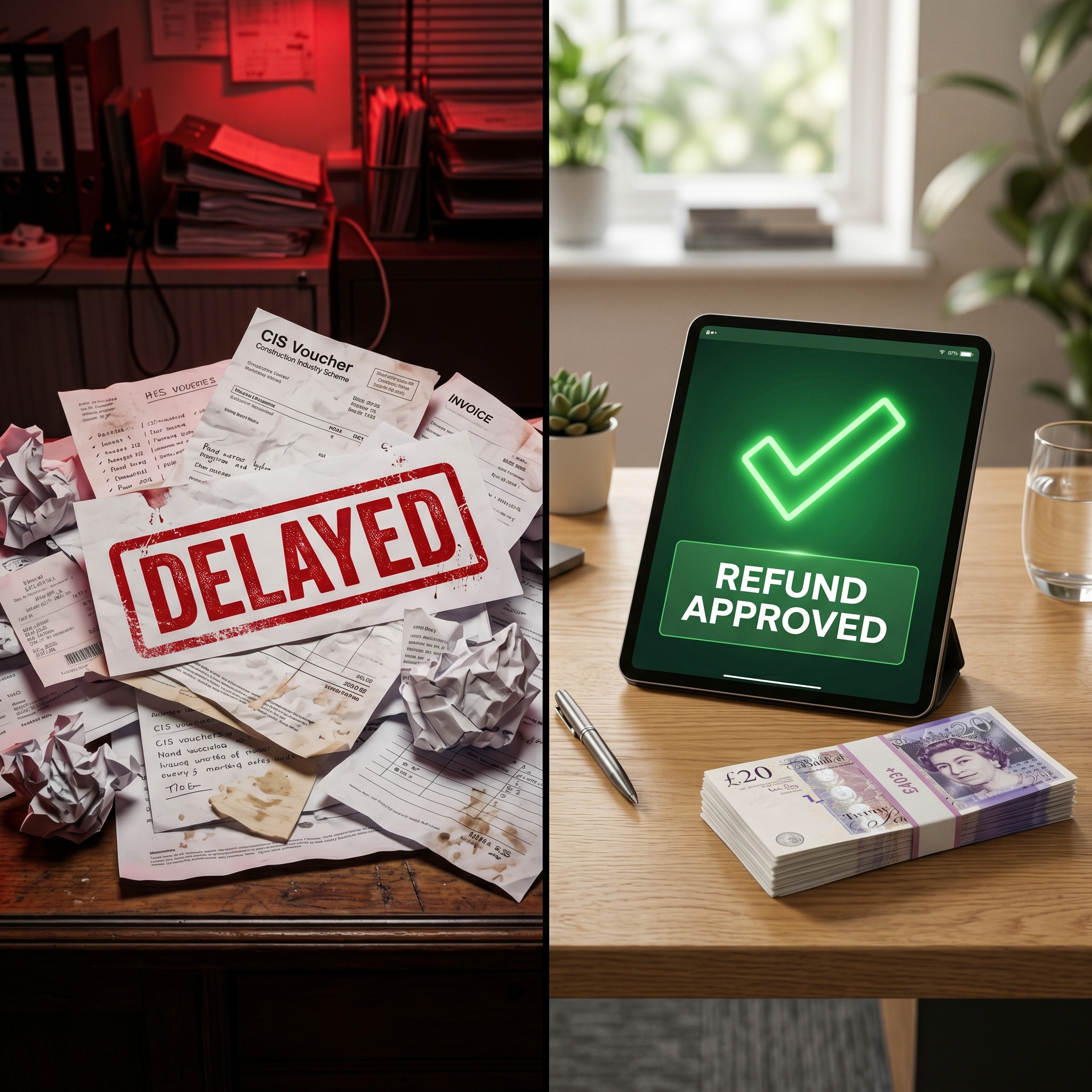
HMRC cross-checks every Self Assessment against your contractors' records. One mismatched figure, one missing voucher, one wrong UTR — and your refund is stuck in manual review for weeks while January's bills pile up.
The CIS refund is the moment most subcontractors look forward to all year. But the difference between a smooth, fast refund and a delayed, queried, or penalty-ridden one comes down to preparation — specifically, what you do in the weeks before 31 January, not the night before.
Why So Many Refunds Get Stuck
HMRC does not simply accept what you submit. Every Self Assessment is automatically cross-checked against the CIS returns filed by your contractors throughout the year. Your figures must align with theirs — income, deductions, dates. Any discrepancy triggers a flag for manual review, and manual review means delays measured in weeks, not days.
The Automatic Cross-Check Every Subcontractor Faces
When you submit your Self Assessment, HMRC's system compares your declared CIS income against the figures your contractors reported on their monthly CIS returns. It checks your deductions claimed against the deduction statements they issued. Any mismatch — even a small one — flags your return for manual review. This is not a targeted investigation. It is an automated filter that catches thousands of returns every year, most of them innocent errors that could have been avoided with thirty minutes of reconciliation before filing.
The Four Most Common Causes of Flagged Returns
HMRC does not assume errors are innocent. A flagged return sits in a queue. Your refund sits with it — for as long as it takes someone to manually review the file.
CIS Tax Insights, 2026The Real Cost of a Single Oversight
The numbers below are not hypothetical. This is the type of calculation that plays out for thousands of CIS subcontractors every January — the difference between what they claimed and what they were entitled to.
| Gross CIS Earnings | £45,000 |
| Legitimate expenses NOT claimed (materials, fuel, tools) | − £6,000 |
| Taxable profit as filed | £45,000 |
| Taxable profit if correctly filed | £39,000 |
| Tax overpaid at basic rate (20%) | £1,200 |
Key Areas Where Subcontractors Go Wrong
Most errors fall into predictable patterns. These are not unusual mistakes — they are the same ones HMRC sees repeated across thousands of CIS returns every year.
You can amend a Self Assessment return up to 12 months after the filing deadline. For the 2024/25 tax year, that means amendments must be submitted by 31 January 2027. After that, most errors become permanent — the overpayment cannot be reclaimed.
The Deadlines That Actually Matter
Most subcontractors only think about 31 January. But there are four dates in the CIS calendar that affect your refund, your penalties, and your cash flow.
Pre-Submission Checklist: Do This Before 31 January
Work through these steps in order, ideally in November or December — not the week before the deadline. Each one takes less time than you think and protects far more than it costs.
-
Collect Every CIS Payment and Deduction Statement Contact every contractor you worked for during the tax year and request your Payment and Deduction Statement if you have not already received one. These are the source documents HMRC uses to verify your income figures. Missing even one means your declared income may not match their records — and that mismatch flags your return.
-
Reconcile Every CIS Payment Against Your Bank Statements For each deduction statement, confirm that the net payment matches your bank record. Add up the gross figures across all statements — this is your total CIS income to declare. Add up the deductions — this is your total tax paid at source. Both numbers must be accurate before you file.
-
Review Every Expense — Apply the "Wholly and Exclusively" Test Go through every expense category: tools, materials, fuel, PPE, training, phone, use of home, professional fees. For each one, ask: could you evidence this as a business cost if HMRC requested proof? If the answer is uncertain, either obtain the evidence now or leave the claim out. An undocumented claim that triggers a review costs far more than the deduction was worth.
-
Check Capital Allowances on Large Purchases Any purchase above roughly £200 that will last more than two years — a van, a compressor, a cordless kit — needs to be considered under capital allowances, not simply expensed. Annual Investment Allowance allows 100% deduction in year one for most plant and machinery, but it must be claimed correctly in the capital allowances section of your return, not as a general expense.
-
Verify Your Personal Details Match HMRC's Records Exactly Check your UTR, National Insurance number, legal name, and current address against what is registered with HMRC. Log into your Government Gateway account to confirm the details. A single character difference — an abbreviated middle name, an old postcode — can cause verification to fail and your return to be flagged before HMRC has even read the content.
-
Retain All Evidence for a Minimum of 5 Years HMRC can open an enquiry up to 12 months after you file — and up to 4 years back for non-deliberate errors, 6 years for careless errors. Every receipt, bank statement, CIS voucher, mileage log, and contract must be stored and retrievable for at least 5 years after the relevant tax return was filed. Digital copies are acceptable — but they must be legible and organised.
DIY or Professional Help? A Simple Decision Framework
Most subcontractors can file their own Self Assessment competently — if their affairs are straightforward. The question is whether your situation genuinely is straightforward.
- One main contractor throughout the year
- Straightforward, well-documented expenses
- Cash basis accounting (no invoices outstanding at year end)
- No capital items, no bad debts, no home office claim
- You have filed successfully in previous years without issues
- Multiple contractors with different deduction rates
- Significant material costs or capital equipment purchased
- Use of Home, bad debt relief, or spouse employment claims
- You operate through a Limited Company or are considering switching
- You received a letter from HMRC about a previous return
- You are approaching or above the 40% tax threshold
A Few Hours Now — Or Weeks of Waiting Later
The subcontractors who receive their refunds quickly in February are not luckier than the ones still waiting in April. They prepared earlier. They reconciled their CIS vouchers before December. They reviewed their expenses before January. They filed with complete, accurate documentation — and HMRC's automated system had nothing to flag.
Start this week. Open your banking app and count how many contractors paid you this year. Request any missing deduction statements now, while the contractors' offices are still reachable. Gather your receipts. Check your UTR. Give yourself the runway to fix anything that needs fixing before the deadline makes every error permanent.
A few hours of preparation in November is worth considerably more than a few weeks of waiting in February — and considerably less than the cost of a penalty, an enquiry, or a permanently missed claim.
QuoteDone Tools
Don't Leave Your Refund to Chance.
Check what HMRC owes you on your CIS deductions — and make sure every invoice is documented and compliant from the start.
This article is for informational purposes only and does not constitute professional tax advice. Always consult a qualified accountant for advice specific to your circumstances. Figures based on 2025/26 HMRC thresholds.