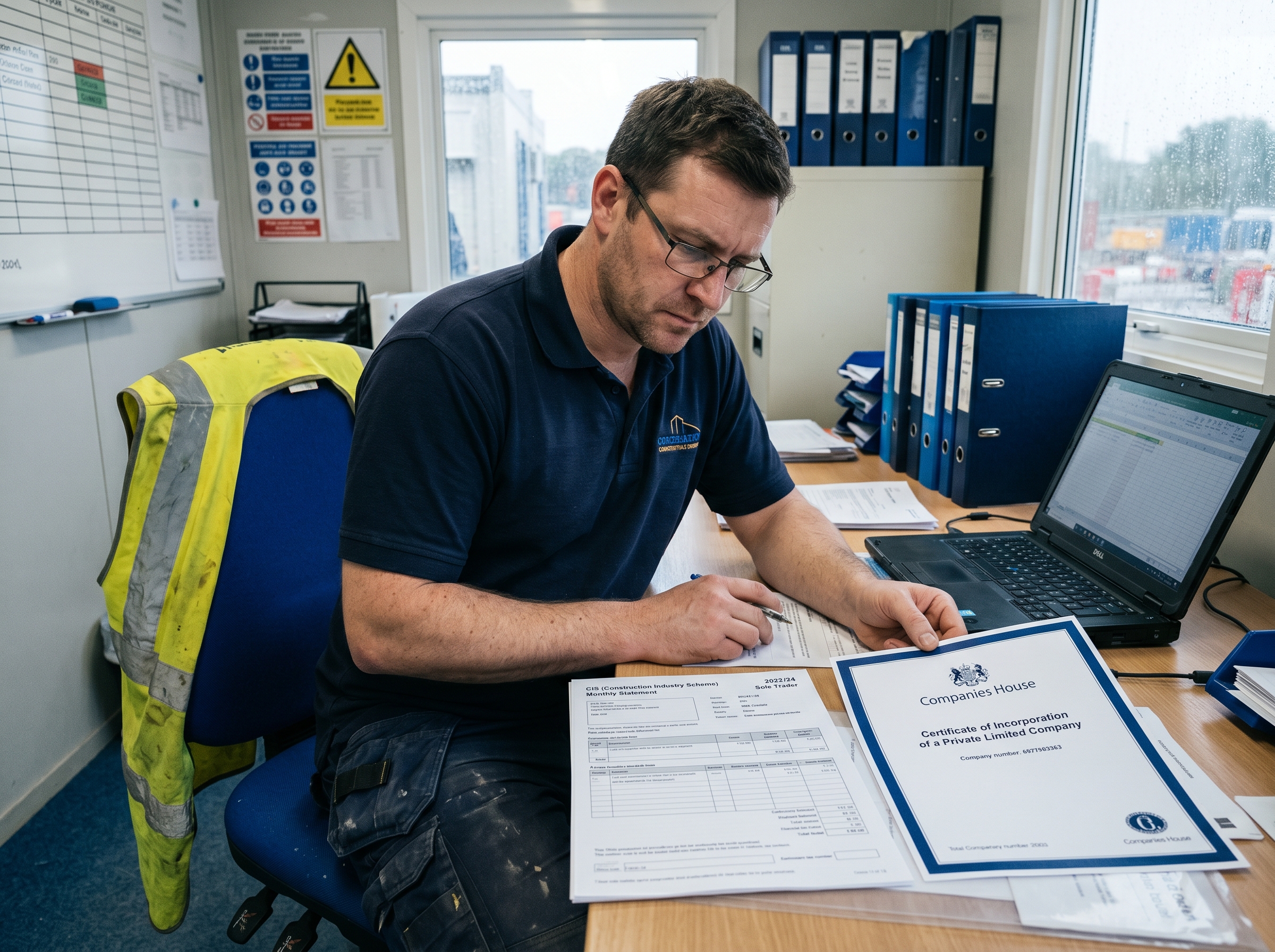
Limited Company · CIS Registration
Incorporating your business is a smart move — but many subcontractors lose thousands because they assume their CIS registration and Gross Payment Status automatically follow them into the new Limited Company. They don't.
Here's a question worth asking before you incorporate: does your new Limited Company know who it is to HMRC? It sounds like a strange question, but it's exactly the gap that catches subcontractors out. When you move from sole trader to a Limited Company, you create an entirely new legal entity from scratch. Your old personal UTR and CIS registration don't transfer with you — and that oversight routinely results in an automatic 30% deduction on every invoice the new company raises, until it's properly registered.
Why Your Personal UTR Stops Working the Moment You Incorporate
Your sole trader UTR belongs to you as an individual — it's tied to your National Insurance number and your personal tax history. The moment you incorporate, the Limited Company becomes a completely separate taxpayer in HMRC's eyes, with its own Corporate UTR issued by Companies House and HMRC once the company is registered.
Using your old personal UTR on company invoices, even by accident or out of habit, is a compliance error that contractors' verification systems will catch. The company doesn't exist on HMRC's CIS register yet under that identity, so the verification fails — and the 30% higher rate applies automatically, exactly as it would for any other unverified subcontractor.
Your Limited Company isn't "you, but incorporated." To HMRC, it's a brand-new entity that has never paid tax, never filed a return, and has no CIS history of its own — until you build that history from scratch.
CIS Tax Insights · 2026Gross Payment Status Doesn't Transfer Either
If you've spent years building toward 0% Gross Payment Status as a sole trader, here's the part that surprises people most: that status belongs to your personal CIS record, not to you as a person who happens to run a construction business. Your new Limited Company has to apply for Gross Payment Status separately, and HMRC will assess it against the same compliance and turnover thresholds as if it were a brand-new applicant — because, on paper, it is.
This application process can take several weeks. In the meantime, the company will be deducted at 20% (if registered for standard CIS) or 30% (if not registered at all) — even though you, personally, may have held Gross Payment Status for years.
What the Gap Actually Costs You
This is a realistic scenario for a subcontractor incorporating mid-year while still invoicing roughly £8,000 a month.
| Monthly invoice value | £8,000 |
| Deduction if registered and verified at standard rate (20%) | −£1,600 |
| Deduction if unregistered or unverified (30%) | −£2,400 |
| Extra cash withheld each month from the gap alone | £800 |
£800 a month doesn't sound catastrophic in isolation — but across a two-month registration gap, that's £1,600 sitting with HMRC instead of in your company's bank account, right at the moment a new business needs working capital the most.
The most damaging version of this mistake is closing your sole trader registration and bank account before the Limited Company's CIS registration is active. If you do this, you can end up with no valid registration at all for a period — sole trader closed, company not yet verified — meaning every invoice during that gap gets deducted at 30% with no way to invoice under your old, established status as a fallback.
How Long Each Step Actually Takes
Plan the transition with real timeframes in mind, not assumptions. These are typical ranges — actual processing times can vary.
Plan for at least 4–6 weeks where both your sole trader registration and your new company's CIS registration could, in theory, be used. You don't need to actively invoice through both — but keeping the sole trader account open and unclosed during this window gives you a fallback if the company's registration takes longer than expected.
Your Sole Trader to Limited Company Transition Checklist
-
Incorporate the Company and Wait for the Corporate UTR Register the company with Companies House first. HMRC will then issue a Corporate UTR specific to the new entity — this is a different number from your personal UTR and is the foundation for everything that follows.
-
Register the Company for CIS Using Its New Details Once you have the Corporate UTR, register the company for the Construction Industry Scheme separately. This is a distinct step from incorporating — many subcontractors assume incorporation automatically includes CIS registration, and it doesn't.
-
Apply for Gross Payment Status for the Company, If Eligible If your turnover and compliance history support it, apply for Gross Payment Status under the company's own name. Don't assume your personal track record carries over — the application is assessed fresh, even if you held 0% status as a sole trader for years.
-
Update Every Contractor With the New Company Details Notify each contractor you work with of the new company name, Corporate UTR, and company bank details before you start invoicing through the Limited Company. A contractor still verifying against your old personal UTR will trigger the same 30% deduction, even if your company registration is otherwise in order.
-
Keep Your Sole Trader Status Active Until the Company Is Fully Approved Don't close your sole trader registration the moment you incorporate. Keep it active until the company's CIS registration — and Gross Payment Status, if you're applying for it — is fully confirmed, so you're never left with no valid registration to invoice under.
Frequently Asked Questions
Can I speed up the Gross Payment Status application for my new company?
There's no official fast-track, but you can avoid unnecessary delays by applying as soon as the company has its CIS registration confirmed and by making sure your turnover and compliance figures are accurate and well-documented from the outset. Incomplete applications are the most common cause of extended processing times.
Do I need to tell HMRC I've stopped trading as a sole trader?
Yes — once the transition is complete and you're no longer invoicing as a sole trader, you'll need to formally tell HMRC you've ceased self-employment, and you'll still need to file a final Self Assessment return covering the period you traded as a sole trader that tax year. Your accountant can confirm the exact timing relative to your company's registration.
What happens to CIS deductions already taken from my sole trader invoices?
Any CIS deductions taken while you were trading as a sole trader are reconciled through your personal Self Assessment for that period, the same as they would be if you'd continued as a sole trader all year. They don't transfer to the company and aren't affected by the transition.
Is it better to wait until the start of a new tax year to incorporate?
It can simplify your paperwork, since it avoids splitting a single tax year between sole trader and company records, but it isn't a requirement. Many subcontractors incorporate when it makes business sense — a new contract, reaching a turnover threshold — rather than waiting for April. If you do incorporate mid-year, just make sure your accountant is clear on the split between the two periods.
Get the Registration Right From Day One
Moving to a Limited Company is a genuine step forward for a lot of subcontractors — better liability protection, often better tax efficiency at higher turnovers, and a more credible structure for larger contracts. None of that is in question.
What trips people up isn't the decision to incorporate — it's assuming the new company inherits your CIS history automatically. It doesn't. Register the company for CIS as its own entity, apply for Gross Payment Status fresh if you qualify, and keep your sole trader account open until everything is confirmed. A few weeks of overlap is a small price for avoiding a 30% deduction on every invoice during the gap.
QuoteDone Tools
Keep Your CIS Position Clear, Whatever Your Structure.
Check what HMRC owes you and keep your invoicing clean and compliant — whether you're trading as a sole trader, a Limited Company, or somewhere in between.
This article is for informational purposes only and does not constitute formal accounting, legal, or tax advice. CIS registration, Gross Payment Status eligibility, and incorporation timelines depend on individual circumstances and HMRC processing times. Always consult a qualified accountant before making structural changes to your business. Aligned to 2026/27 HMRC guidance.