Most subcontractors think their biggest tax problem is the 20% CIS deduction. It isn't. Once your profits start climbing, the structure you're working under quietly costs you far more — and most people never look at it until it's too late.
You've been grafting. The work is consistent, the invoices are going out, and the money coming in is better than it's ever been. But somewhere between your gross turnover and what actually lands in your account, a significant chunk disappears — not to CIS, but to the way your business is set up.
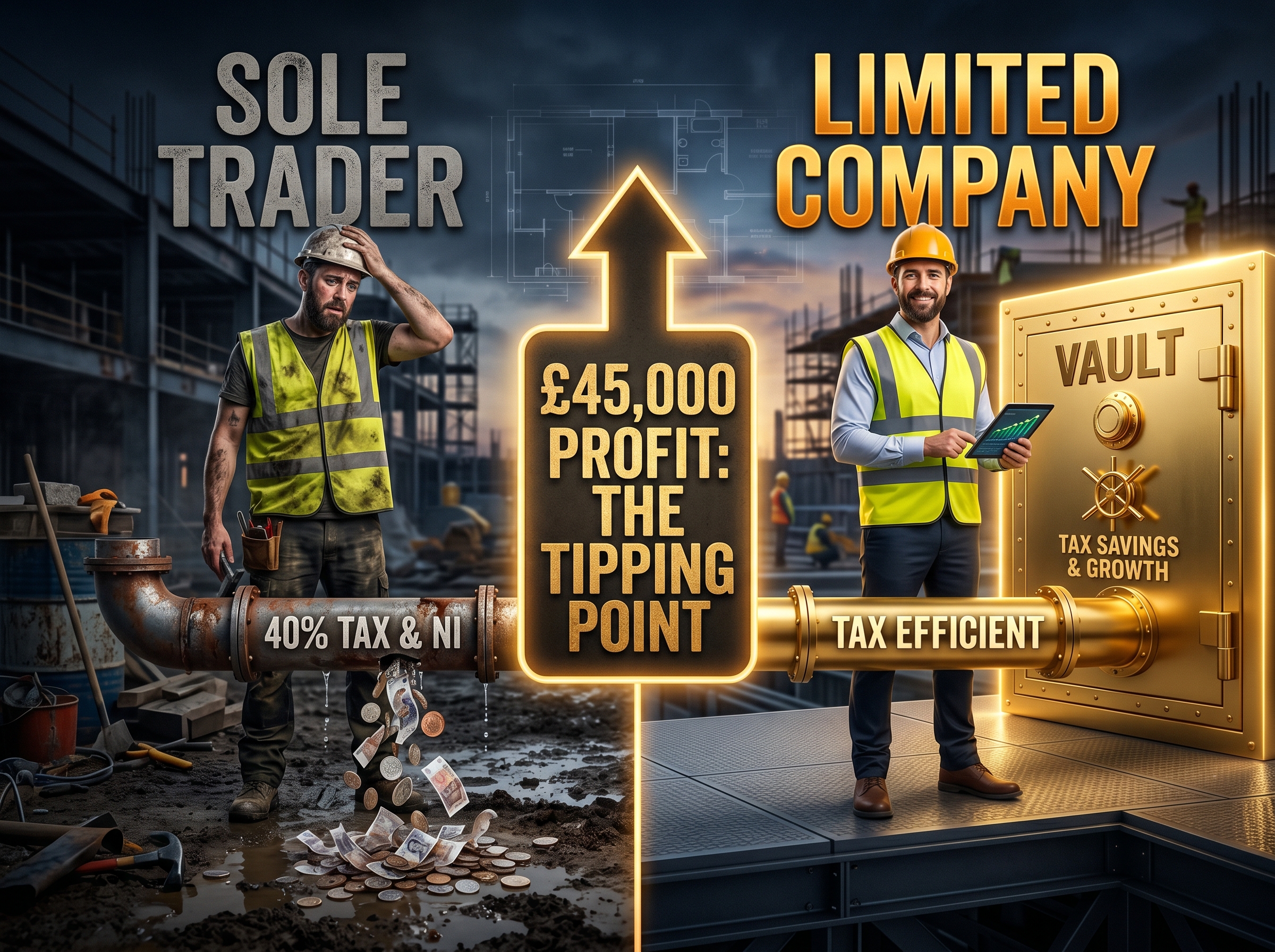
If your annual profits are consistently above £45,000, you may be at the point where staying a Sole Trader is costing you more than it's saving you in simplicity. A Limited Company isn't just for big firms or people trying to avoid tax. Used correctly, it's a legal structure that reflects how the UK tax system is actually designed to work.
Why Sole Traders Pay More Tax as They Scale
As a Sole Trader, HMRC taxes 100% of your business profits as personal income. The moment you cross £50,270, you enter the higher-rate band: 40% Income Tax plus 2% Class 4 National Insurance on every pound above that line. There's no flexibility, no timing, no structure — it's all taxed the same way regardless.
A Limited Company pays Corporation Tax on its profits — 19% up to £50,000, rising gradually to 25% above £250,000. More importantly, you as a director can then extract money through a combination of a low salary and dividends, which sit in a different, more favourable tax category. The same £60,000 profit is taxed through a fundamentally different route — and that route is cheaper.
| Factor | Sole Trader | Limited Company (optimised) |
|---|---|---|
| How profit is taxed | Income Tax + Class 4 NI on 100% of profits | Corporation Tax on profits + dividend tax on extraction |
| Approx. total tax & NI | £18,000 – £19,500 | £15,500 – £17,500 |
| Approx. take-home | £40,500 – £42,000 | £42,500 – £44,500 |
| Annual saving potential | — | £2,000 – £3,000+ |
| Admin complexity | Simple — Self Assessment only | Higher — accountant strongly advised |
| Personal liability | Unlimited — personal assets at risk | Limited — company assets only (generally) |
The Protection Argument — More Important Than It Sounds
Tax savings aside, limited liability matters in construction. When something goes wrong on site — a dispute with a contractor, a supplier claim, an injury — a Sole Trader's personal assets are in the frame. Your house. Your savings. Your van that's registered in your name.
A Limited Company creates a legal barrier between the business and your personal life. It isn't bulletproof — directors can still be personally liable in cases of fraud or negligence — but for the everyday risks of running a construction subcontract business, it's meaningful protection that Sole Trader status simply doesn't offer.
Larger main contractors are increasingly reluctant to use unincorporated subcontractors on bigger projects too. A Ltd company can open doors that sole trader status quietly closes.
What You Need to Know Before You Switch
| Consideration | What It Means for You |
|---|---|
| Accountancy costs | Budget £1,200 – £2,000+ per year for a proper Ltd company accountant. Below £45k profit, this often erases the tax saving entirely. |
| CIS registration | Your company must register for CIS separately. You will typically start on 20% deduction and can apply for Gross Payment Status (0%) once you have a clean compliance record under the new entity. |
| Making Tax Digital | From April 2026, Sole Traders with income over £50k must file quarterly MTD updates. A Limited Company avoids this obligation for business profits — one less admin burden. |
| Salary + dividends strategy | The tax saving only materialises if you structure your extraction correctly. A low salary (around £12,570) plus dividends is the standard approach — but dividend tax rates increased in April 2026, so the numbers need modelling for your specific situation. |
| Going back | Closing a Limited Company involves striking off or liquidation — neither is instant or free. Only incorporate when your income is stable and you've had the conversation with an accountant. |
The One Question That Decides It
Forget the percentages for a moment. The single most useful question to ask yourself is this: is your profit reliably above £45,000, and do you expect it to stay there?
If the answer is yes — and your work isn't heavily concentrated with one contractor in a way that creates IR35 risk — a Limited Company is worth modelling seriously with an accountant who understands CIS. The structure alone won't make you richer. Used correctly, it keeps more of what you've already earned.
Not sure which structure fits your situation?
Every subcontractor's position is different — especially in construction where CIS, IR35, and VAT Reverse Charge all interact. The right next step is a quick review with an accountant who knows the industry.
Get a Free Structure ComparisonFrequently Asked Questions
Sole Trader vs Limited Company · UK Construction 2026
When is the right time to switch from Sole Trader to Limited Company in 2026?
The switch typically becomes worthwhile when your net profit consistently exceeds £45,000–£50,000 per year and you expect it to remain at that level or grow. Below £40,000–£45,000, the additional accountancy costs — typically £1,200–£2,000 per year — often cancel out the tax saving. The decision should also account for IR35 risk, your CIS situation, and whether you work for multiple contractors or predominantly one.
Does switching to a Limited Company change my CIS deductions?
Yes — your new company must register for CIS as a separate entity and will initially be subject to the 20% standard deduction rate. Your previous Sole Trader CIS registration does not transfer. You can apply for Gross Payment Status (0% deduction) once the company has a clean compliance record, typically after 12 months of trading. Many subcontractors do achieve GPS, but it requires up-to-date tax filings and no outstanding liabilities.
What is IR35 and how does it affect CIS subcontractors with a Limited Company?
IR35 (also called Off-Payroll Working rules) is HMRC's test for whether someone operating through a Limited Company is effectively an employee in disguise. If your engagement looks like employment — one main client, set hours, equipment provided by the contractor, no substitution rights — HMRC may rule you "inside IR35" and tax your company income at employment rates. In that scenario, a Limited Company can actually cost you more than staying as a Sole Trader. IR35 risk assessment is essential before you incorporate.
Can I reverse the decision and go back to being a Sole Trader?
Yes, but it's not straightforward. Closing a Limited Company requires either a formal striking-off process (voluntary dissolution, typically £8–£20 via Companies House) or a liquidation if there are significant assets or liabilities involved. The process takes a minimum of three months. This is why the decision to incorporate should only be made when your income is stable and you've had a detailed conversation with an accountant — not as an experiment.
How does Making Tax Digital affect Sole Traders in construction from 2026?
From April 2026, Sole Traders and landlords with combined income above £50,000 must comply with Making Tax Digital for Income Tax (MTD for ITSA). This means submitting quarterly digital updates to HMRC in addition to an annual Self Assessment return — a significant increase in admin. A Limited Company is not subject to MTD for ITSA on its business profits, which removes this obligation. For subcontractors already managing CIS, VAT Reverse Charge, and Self Assessment, removing one layer of compliance has practical value beyond the tax saving alone.