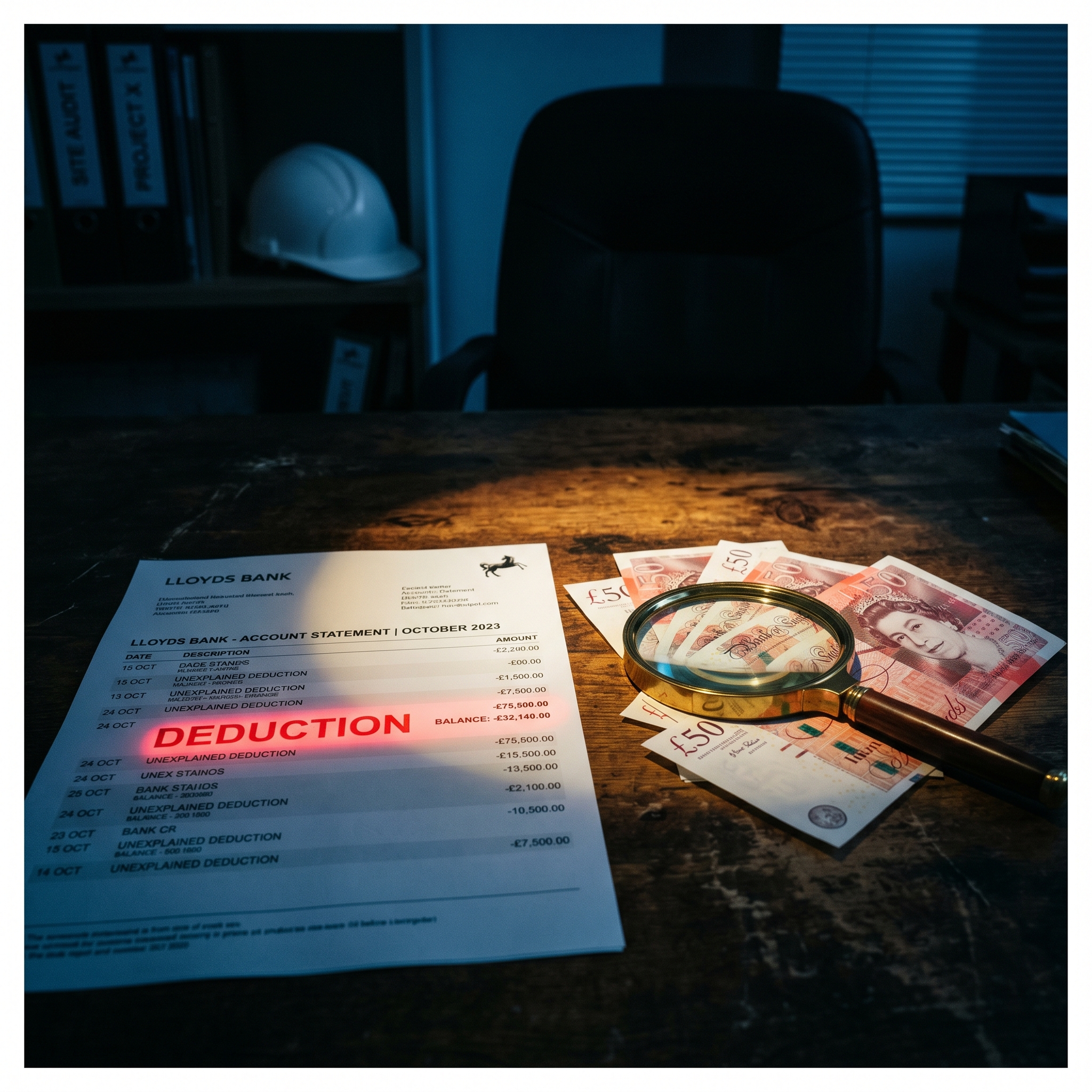
When a contractor takes 20% from your pay but fails to report it, HMRC has no record of the deduction. Come January, they'll ask you to pay it again — and proving you already paid it falls entirely on you.
The 60-second version
- If a contractor takes your 20% CIS deduction but doesn't file their monthly return, HMRC has no record of it — and may ask you to pay the same tax again.
- The burden of proof is on you. Your bank statements and invoices are your strongest evidence.
- Recovery takes three steps: build your evidence, send a formal written demand with a 14-day deadline, then report to HMRC's CIS helpline on 0300 200 3210.
- Start now, not in January. Missing credits from previous years can still be reclaimed, going back up to four tax years.
Here's a question worth two minutes of your time: when did you last check that the CIS deductions taken from your pay actually appear on your HMRC account? If the honest answer is "never" or "at tax return time", keep reading.
You've done the job. The invoice went out for £10,000. Your contractor paid £8,000 — the 20% CIS deduction held back, ready to be passed to HMRC on your behalf. That's how the scheme is supposed to work.
But if the contractor doesn't file their monthly CIS return, or files it incorrectly, HMRC sees something different: a subcontractor who earned £10,000 and paid zero tax. Your Self Assessment arrives in January. HMRC asks for £2,000. And the £2,000 that was already taken from your pay — the money sitting in your contractor's account, or spent — is your problem to prove.
Think of it like handing someone £2,000 to pay a bill on your behalf. If they never pay it, the bill doesn't disappear — and the company chases you, not them.
How the Double-Tax Problem Works
£10,000 invoice · 20% CIS rate · contractor fails to file monthly return
Contractors are legally required to provide a Payment and Deduction Statement (PDS) for every tax month in which a deduction is made, and to file their CIS return with HMRC by the 19th of the following month. Failure to do so is a compliance breach — and HMRC can penalise the contractor. But it does not automatically restore your missing credit. That is a separate process you must initiate yourself.
Contractor Penalty ≠ Your Refund: Who Deals With What
This is the "aha" moment most subcontractors miss: HMRC punishing the contractor and HMRC crediting you are two completely separate tracks. One does not trigger the other.
| Situation | What can happen to the contractor | What it means for you |
|---|---|---|
| Monthly CIS return not filed | A compliance breach — HMRC can issue penalties | Your missing credit is not restored automatically |
| Deductions deliberately withheld | Can constitute fraud — HMRC can investigate and pursue recovery from the contractor | You still need to start your own credit claim |
| Proving the deduction happened | HMRC can investigate the contractor's filing record | The burden of proof sits with you |
Why Contractors Miss CIS Returns (and Why You Carry the Risk)
Some contractors fail to file returns through genuine disorganisation — late bookkeeping, staff turnover, software problems. Others do it deliberately, knowing the cash-flow benefit of holding onto deducted funds. In either case, the subcontractor carries the risk.
4 Warning Signs Your CIS Deductions Are Missing
How many of these sound familiar?
Tomasz works a full month for a contractor. Invoice total: £10,000. He's paid £8,000 — the contractor tells him the £2,000 CIS deduction has been passed to HMRC.
In January, Tomasz files his Self Assessment expecting a small refund. Instead, HMRC shows £0 in CIS credits for that month. His assessment shows £2,000 owed — the same £2,000 that was already taken from his pay.
Tomasz has his bank statement showing he received £8,000, not £10,000. But without a PDS or HMRC record of the deduction, he faces months of correspondence to recover a credit he was already entitled to — and must still pay if HMRC doesn't accept his evidence in time.
The frustrating part? A monthly check of his HMRC account would have flagged the gap months earlier — long before a tax bill was due.
How to Recover Missing CIS Deductions in 3 Steps
Build your evidence file — before you contact anyone
HMRC places the burden of proof on you, not the contractor. Before making any calls or sending any letters, gather:
- Bank statements showing every net payment received (these prove a deduction was made)
- All invoices you issued in the relevant period
- Any PDS statements you did receive
Clear, consistent invoices make this step far easier — they're the other half of the proof. If yours are scattered, our free CIS invoice generator keeps every future invoice clean and consistent.
Send a formal written demand to the contractor
A phone call won't create a paper trail. Send an email and follow it with a letter sent via recorded delivery. Be direct and use language that signals you know your rights. You can copy this wording:
Copy & send
"Please provide Payment and Deduction Statements for the following months: [list]. These are a legal requirement under the Construction Industry Scheme. I require them within 14 days to reconcile my tax position with HMRC. Failure to provide them will result in a report to HMRC's CIS Compliance team."
Report to HMRC and submit your own evidence directly
If the contractor does not respond within 14 days, contact HMRC's CIS helpline on 0300 200 3210. Report the missing returns and submit your bank evidence. HMRC can investigate the contractor's filing record and, in some cases, apply the credit to your account based on your evidence alone — but this process takes time.
Do not wait until January to start it. The earlier you report, the more likely the credit is resolved before your Self Assessment is due.
Once your missing credits are back on your HMRC account, see what your CIS refund could look like.
Try the free CIS refund calculator →When to Act: The Window That Matters
The 5-Minute Monthly Routine That Protects You
The best defence against missing deductions is a system that catches the problem immediately rather than in January. After every payment received:
- Match the numbers. Check that the net payment in your bank equals your invoice minus the expected CIS deduction.
- Check HMRC monthly. Log in to your HMRC Personal Tax Account (gov.uk) and confirm the CIS credits are appearing. Any gap is a flag to investigate immediately.
- Chase the PDS. Request it in writing if it hasn't arrived within a week of payment — don't wait and don't assume it's coming.
- Keep a simple log. It takes five minutes a month and is your entire defence if a dispute arises.
Here's what that log can look like, using Tomasz's month as an example:
| Date | Contractor | Gross invoice | Net received | PDS received? |
|---|---|---|---|---|
| [Date] | [Contractor name] | £10,000 | £8,000 | No → chase in writing |
Frequently Asked Questions
Missing CIS deductions · contractor negligence · HMRC 2026
What is a Payment and Deduction Statement and am I entitled to one?
A Payment and Deduction Statement (PDS) is a document your contractor must provide for every tax month in which they make a CIS deduction from your pay. It shows the gross payment, the amount deducted, and the net amount paid to you. You are legally entitled to receive it. Without it, you cannot reconcile your CIS credits with HMRC and may struggle to claim your refund or defend against a tax demand. If your contractor is not providing PDS statements, request them in writing immediately.
What can I do if my contractor deducted CIS but didn't pass it to HMRC?
First, gather your evidence: bank statements showing net payments received, your invoices, and any PDS documents. Then send the contractor a formal written request for missing statements with a 14-day deadline. If they do not respond, contact HMRC's CIS helpline on 0300 200 3210 to report the non-compliance and submit your bank evidence directly. HMRC can investigate the contractor's filing record and apply credits to your account based on your evidence. Do not wait until January — the earlier you report, the better your chance of having the credits resolved before your Self Assessment is due.
How do I check if my CIS deductions have been recorded by HMRC?
Log in to your HMRC Personal Tax Account at gov.uk. Under your Self Assessment or CIS section, you can view the deductions that have been reported against your UTR for the current and previous tax years. Check this monthly — don't wait until January. If a month shows £0 in CIS credits but you know a deduction was made, contact the contractor immediately and follow up with HMRC if you receive no response within 14 days.
Can I reclaim CIS deductions that went missing in a previous tax year?
Yes — you can submit an overpayment relief claim or amend your Self Assessment return going back up to four tax years. You will need evidence that the deduction was made (bank statements showing net payments, invoices, any PDS documents). A CIS-specialist accountant can reconstruct the missing credits from your records, identify the correct amounts, and submit the claim to HMRC on your behalf. The older the year, the more important it is to have organised records — HMRC will scrutinise older claims more carefully.
Is it fraud if a contractor deducts CIS but doesn't pay it to HMRC?
Deliberately withholding CIS deductions that have been taken from a subcontractor's pay and not passing them to HMRC is a serious compliance breach — and in cases of deliberate non-payment, it can constitute fraud. HMRC takes CIS non-compliance seriously and has the power to issue penalty notices, conduct investigations, and pursue recovery from the contractor. If you believe a contractor is deliberately withholding your deductions rather than simply failing to file on time, you can report it to HMRC's fraud hotline (0800 788 887) in addition to the standard CIS helpline. This does not resolve your credit directly, but it triggers a more urgent HMRC investigation.