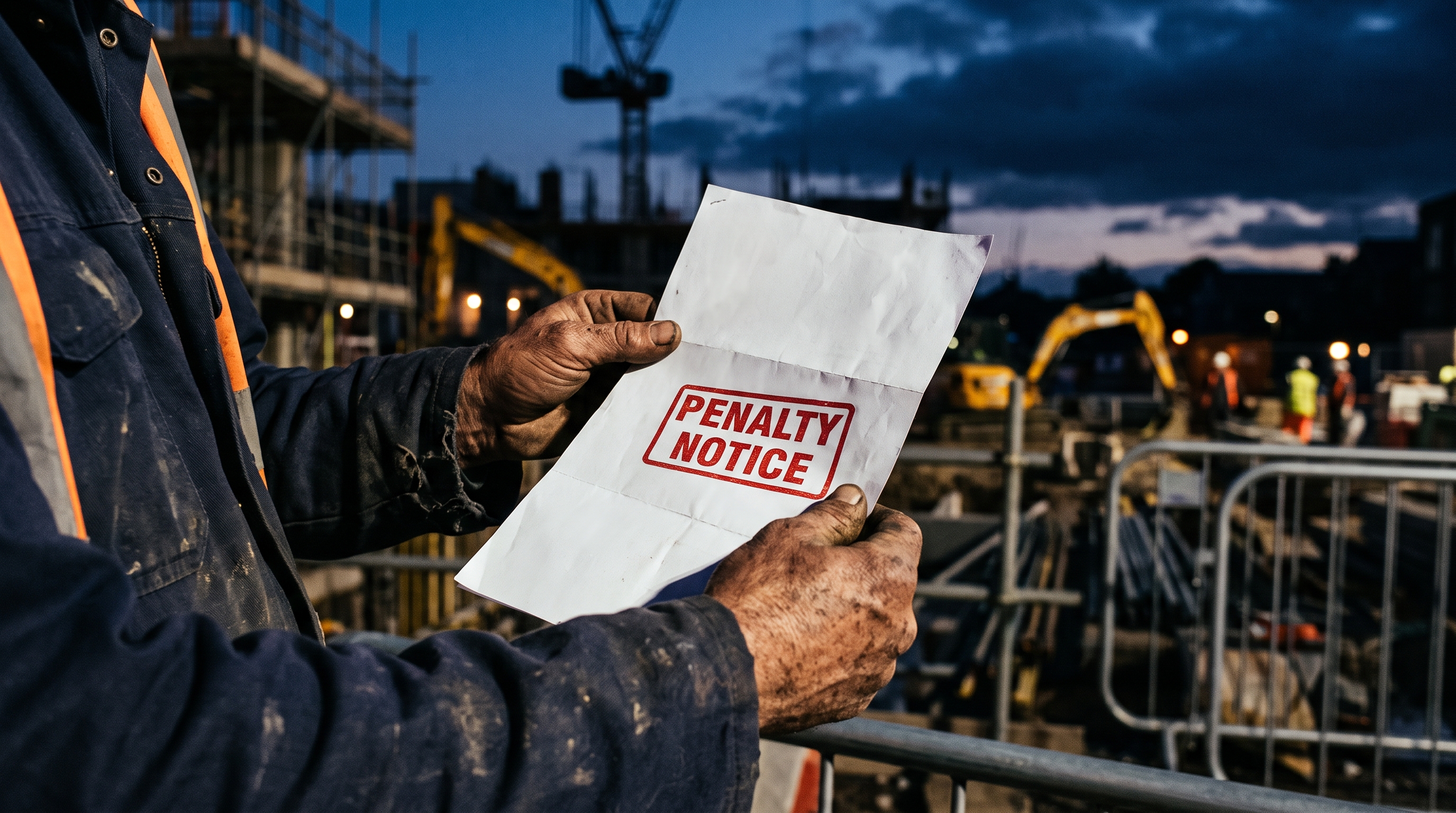
What Happens If You Miss the 31 January Self Assessment Deadline?

HMRC issues a £100 automatic penalty the moment 31 January passes — and the charges escalate fast. This guide covers every penalty trigger date, real-world cost scenarios for CIS subcontractors, and exactly what to do if you've already missed the deadline.

Back to all articles

CIS Tax / Self Assessment · 7 min read ·

What Happens If You Miss the 31 January Self Assessment Deadline?
Self Assessment · Tax Year 2025/26 · Online Deadline: 31 Jan 2027

The penalties are automatic, they stack fast, and HMRC doesn't send a warning first. Here's the exact cost timeline — and what CIS subcontractors can still do about it.

Last updated: September 2026 · Information correct as at HMRC guidance for tax year 2025/26

£100

Automatic penalty
from Day 1

£10/day

Daily penalty from
month 3 (max £900)

£1,000

Maximum total
penalty by month 6

Most CIS subcontractors know the 31 January deadline exists. Fewer know exactly what happens the moment it passes — or how quickly a small delay compounds into a serious bill. This guide lays out every penalty, every trigger date, and every option you have to reduce the damage.

⚠ Important HMRC issues the £100 penalty automatically — even if your tax return shows you owe nothing, and even if you're owed a refund. There is no grace period and no warning letter before the charge is applied.

Why CIS Subcontractors Must File Self Assessment

Under CIS, your contractor deducts 20% (registered) or 30% (unregistered) from your labour payments throughout the year and pays it to HMRC on your behalf. But those deductions are rarely the exact amount you actually owe in tax — almost always, you've overpaid.

Self Assessment is how you claim that money back. Without a filed return, HMRC keeps it. For many subcontractors, the refund is £500 to £3,000+ per year. Missing the deadline doesn't just create a penalty — it delays, and risks, your refund.

How Much CIS Tax Are You Owed?

Most subcontractors are due a refund. Find your number in 60 seconds.

CHECK YOUR REFUND NOW →

✓ No registration required · 100% Free · HMRC 2025/26 Aligned

The Exact Penalty Timeline — Day by Day

HMRC's penalty structure for late Self Assessment returns is layered. Each milestone triggers a new charge. Here's precisely what happens and when:

HMRC Late Filing Penalty Schedule — Tax Year 2025/26 (Online Deadline: 31 January 2027)
Day 1 (1 Feb 2027)
£100 fixed penalty — automatic, no exceptions
3 Months Late (1 May 2027)
£10 per day · up to 90 days · maximum additional £900
6 Months Late (1 Aug 2027)
Greater of £300 or 5% of tax due
12 Months Late (1 Feb 2028)
Further £300 or 5% of tax due (higher applies)
Deliberate Withholding
Up to 100% of tax due (investigation triggered)
Interest on Unpaid Tax
BoE base rate + 2.5pp from 1 February (confirmed by HMRC each period)

Source: HMRC — Self Assessment penalties (gov.uk)

"A subcontractor who misses 31 January by six months — and has £2,000 of tax to pay — faces approximately £1,200 in penalties and interest before a single penny is paid. The return takes less than an hour to file."

Three Real-World Scenarios

Scenario A: Filed 6 Months Late, No Tax Owed

Subcontractor with zero tax liability — files on 30 July 2027 (6 months late, one day before the 6-month surcharge)
Tax owed to HMRC
£0
Day 1 penalty
£100
Daily penalties (90 days × £10, months 3–6)
£900
Total cost of filing a nil return late
£1,000
6-month surcharge applies?
No — surcharge is 5% of unpaid tax. No tax owed = no surcharge.

Scenario B: Filed 7 Months Late, £3,500 Tax Owed

Subcontractor with tax liability — files in August 2027 (7 months late)
Tax owed
£3,500
Day 1 penalty
£100
Daily penalties (90 days × £10)
£900
6-month surcharge (5% of £3,500)
£175
Interest (approx. 7 months at BoE + 2.5pp)
~£150
Total additional cost on top of tax
~£1,325

Scenario C: Owed a Refund, Filed 4 Months Late

Subcontractor due a £1,800 CIS refund — files in May 2027 (4 months late)
CIS refund due from HMRC
£1,800
Day 1 penalty
£100
Daily penalties (~30 days × £10, from month 3)
£300
Net refund received after penalties offset
£1,400
Refund lost to penalties
£400 — entirely avoidable
🚨 Risk HMRC can offset penalties against a refund you're owed. Filing late doesn't just cost you money — it reduces the refund you've already earned through CIS deductions across the year.

Can HMRC Waive the Penalty? Reasonable Excuse Explained

Yes — but the bar is higher than most people assume. HMRC uses the phrase "reasonable excuse," defined as something outside your control that prevented you from filing on time. You must appeal within 30 days of receiving the penalty notice.

What HMRC Accepts as Reasonable Excuse

  • Serious illness or hospitalisation (you or an immediate family member in your care)
  • Death of a close relative shortly before the deadline
  • Fire, flood, theft, or loss of records beyond your control
  • HMRC's own online systems being unavailable — must be documented
  • Postal delays preventing return receipt (paper returns only)
  • A disability that made filing impossible without reasonable assistance that was unavailable

What HMRC Does NOT Accept

  • Forgetting the deadline or not being aware of it
  • Relying on someone else (accountant, spouse) who didn't file on your behalf
  • Financial difficulty paying the tax bill (separate from the return itself)
  • Being too busy with work
  • Not receiving a reminder from HMRC
✅ Best Practice Appeal using form SA370 or through your HMRC online account at gov.uk. State the excuse clearly, include exact dates, and attach supporting evidence (GP letters, hospital discharge notes, utility company flood reports). Vague appeals are routinely rejected.

What to Do If You've Already Missed the Deadline

The single most important action is the same regardless of how late you are: file the return immediately. Every additional day costs money. Here's the exact process:

  1. 1

    File your return now — don't wait. Log in to HMRC online services at gov.uk/log-in-file-self-assessment-tax-return. The longer you wait, the more daily penalties accumulate. A partially correct return filed on time beats a perfect one filed late.

  2. 2

    Gather your CIS statements. Your contractors must have provided monthly CIS deduction statements. You'll need the total gross payments and the total deducted to complete the self-employment sections correctly.

  3. 3

    Claim every allowable expense. Tools, mileage (45p/mile for the first 10,000 miles — the HMRC Approved Mileage Allowance Payment rate for cars and vans), PPE, and relevant training all reduce your taxable income. Don't rush past expenses to file quickly — they directly reduce what you owe.

  4. 4

    Pay any tax owed immediately. Paying the bill stops interest accruing. If you can't pay in full, set up a Time to Pay arrangement via HMRC before interest and surcharges compound further.

  5. 5

    Appeal the penalty if you have reasonable grounds. Use form SA370 or HMRC's online appeals service within 30 days of the penalty notice. Include exact dates, a factual account, and supporting evidence.

⚠ CIS Deduction Box — Don't Get This Wrong When filing on SA103S (short tax return), enter your CIS deductions in Box 38. On SA103F (full return), use Box 82. Entering deductions in the wrong box is one of the most common CIS filing errors and will delay your refund.

Can't Pay? HMRC Time to Pay Arrangements

✅ Critical Distinction: Filing vs Paying Filing your return on time and paying your tax bill are two completely separate obligations. You can file with zero money in your account and face zero late-filing penalties. The 5% surcharges at 6 and 12 months apply only to unpaid tax — not to the return itself. If you owe nothing, no surcharge ever applies regardless of when you file.

A late return penalty and a late payment penalty are two separate things. Filing the return stops the filing penalties — even if you can't pay the tax yet. If you owe tax you can't pay immediately, contact HMRC's Self Assessment helpline: 0300 200 3310.

Time to Pay (TTP) spreads the debt over monthly instalments. HMRC generally expects full payment within 12 months, and interest continues to accrue on the outstanding balance — but the 5% payment surcharges at 6 and 12 months can be avoided if a TTP agreement is in place before those dates.

Time to Pay vs. No Action — Cost Comparison on £2,000 Tax Owed
TTP agreed by 1 February 2027
£2,000 + interest only (approx. £120 over 12 months at current rates)
No action — paid at 6 months
£2,000 + £100 + £900 + £100 surcharge + ~£120 interest = ~£3,220
No action — paid at 12 months
£2,000 + £100 + £900 + £200 surcharges + ~£240 interest = ~£3,440+

How to Make Sure This Never Happens Again

  • Register for Self Assessment as soon as you start working under CIS — don't wait until October
  • Set a calendar reminder for 31 October (paper deadline) and 31 January (online deadline) every year
  • Keep a running total of CIS deductions using your monthly statements from each contractor
  • Record all allowable expenses as you go (tools, mileage at 45p/mile, PPE) — not in a January panic
  • Use QuoteDone's free CIS invoice generator to keep every invoice correctly formatted and auditable
  • If you use an accountant, confirm they've filed by mid-January — never assume it's done
ℹ General information only. This article provides general guidance on HMRC Self Assessment penalties and is not tailored tax advice. Tax rules can change and individual circumstances vary. Always verify current rates and deadlines directly with HMRC (gov.uk) or consult a qualified accountant. Last reviewed: September 2026.

People Also Ask — Self Assessment Deadline

What is the penalty for missing the 31 January Self Assessment deadline?
An automatic £100 fixed penalty applies from 1 February — regardless of whether you owe any tax. After 3 months, daily £10 penalties begin (up to £900 over 90 days). A further 5% surcharge on unpaid tax applies at 6 months and again at 12 months.
Can HMRC waive a late filing penalty?
Yes, if you can demonstrate a reasonable excuse — such as serious illness, bereavement, or a documented HMRC system failure. Appeal using form SA370 or HMRC's online service within 30 days of the penalty notice. Forgetting the deadline does not qualify.
What counts as a reasonable excuse for HMRC?
HMRC accepts: serious personal illness or hospitalisation, death of a close relative, fire/flood/theft destroying records, HMRC's own online service being unavailable (documented), or postal delays beyond your control. Financial difficulty, forgetting the deadline, or relying on someone else do NOT qualify.
Do I still owe a penalty if I have no tax to pay?
Yes. The £100 fixed penalty is for filing the return late — not for unpaid tax. Even a nil return or one showing a refund will attract the penalty if filed after 31 January.
What is the HMRC interest rate on late tax payments?
HMRC charges interest at the Bank of England base rate plus 2.5 percentage points on any unpaid tax from 1 February. The rate is confirmed by HMRC each period and accrues daily until the balance is settled in full.
As a CIS subcontractor, do I still need to file Self Assessment?
Yes. Most CIS subcontractors must file annually to reclaim overpaid CIS deductions, declare self-employment income, and claim allowable expenses. Without filing, HMRC retains the excess deductions.
What if I can't pay the tax I owe?
File the return regardless — filing stops the filing penalties even if you can't pay. Then call HMRC's Self Assessment helpline (0300 200 3310) to arrange a Time to Pay plan before further surcharges are triggered at 6 months.

Ready to claim your CIS refund?

Use our free calculator to find out what HMRC owes you — most subcontractors are due money back.

CHECK YOUR REFUND NOW →

Need professional invoices fast?

Create clean, compliant CIS invoices in seconds with our free tool. No account needed.

TRY FREE INVOICE GENERATOR →