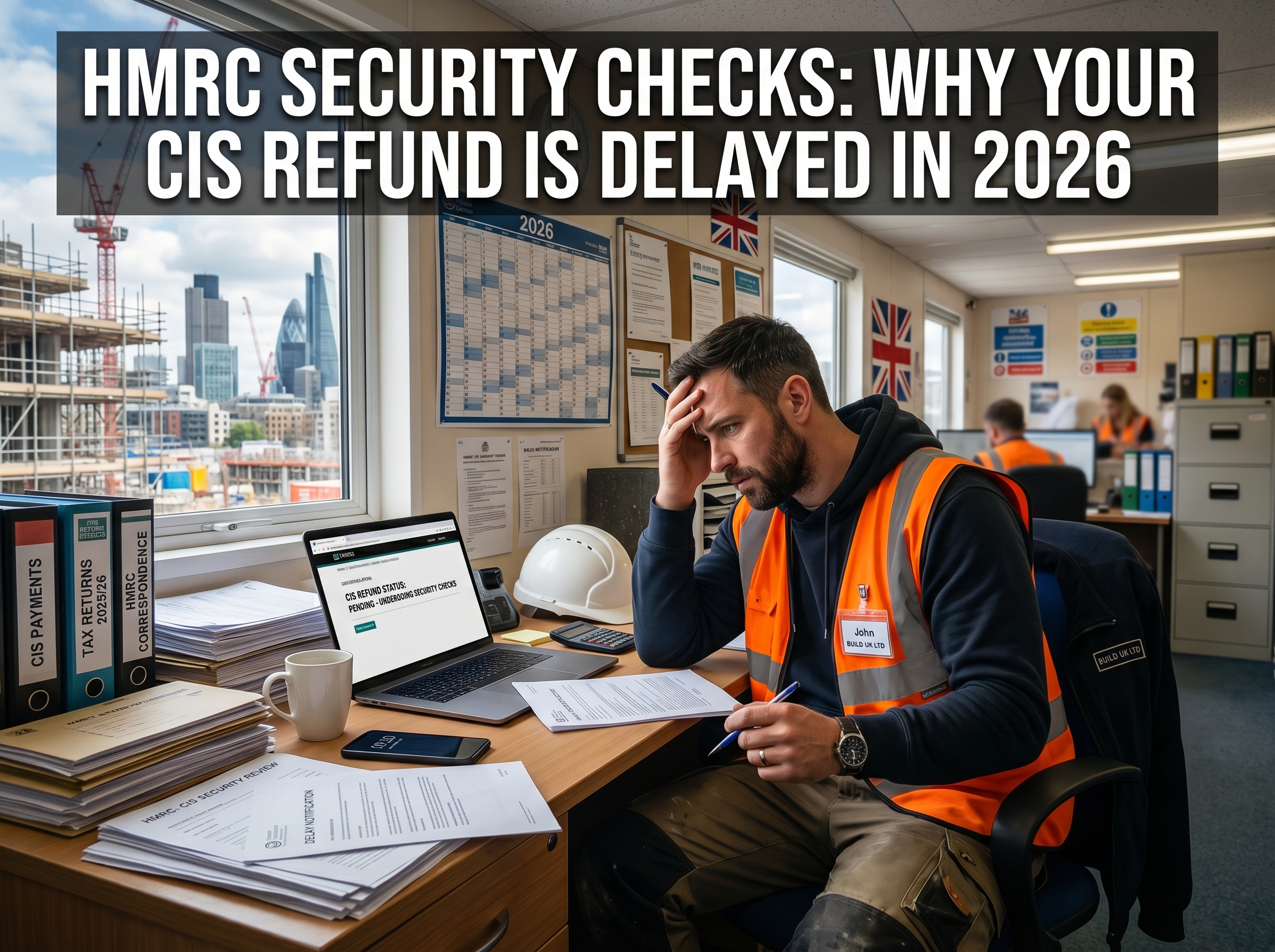
CIS Refund Delayed in 2026?
Here's Exactly Why HMRC
Is Holding Your Money
You're owed thousands of pounds in overpaid CIS tax — and it's still sitting with HMRC. Here's what's really going on, and what you can do right now.
once under review
delays reported
call wait time
Why Your CIS Refund Is Taking So Long Right Now
HMRC doesn't delay refunds randomly. When your payment is held up, there's always a reason — and in 2026, the landscape is worse than it's been in years.
A combination of structural problems has stacked up behind the scenes. HMRC staff carried out industrial action from December 2024 through June 2025, creating a backlog that is still being worked through. Accountants on professional forums are reporting clients who submitted in April 2025 and were told not to expect a response until March 2026 — nearly 12 months later.
On top of that, staff shortages, the rollout of Making Tax Digital for Income Tax (which begins in April 2026), and enhanced fraud prevention checks are all slowing the system down.
The Most Common Reasons Your Specific Refund Is Stuck
Even within a delayed system, some returns move through quickly. Others get flagged for manual review. Here's what triggers that check:
- Mismatched CIS figures. Your declared income or CIS tax suffered doesn't match what your contractors reported to HMRC on their monthly returns. This is the single most common cause.
- Unusual expense claims. High mileage, materials or tool costs without clear supporting evidence — especially invoices and receipts that align with your bank statements.
- Small data errors. An outdated address, incorrect UTR, or bank details that don't match HMRC's records can freeze a refund completely.
- Outstanding liabilities. HMRC will offset any unpaid tax, penalties or PAYE debt against your refund before releasing the balance.
- First-time claimants. If you've never claimed a CIS refund before, HMRC routinely runs additional identity and registration checks.
- Large refund amounts. Claims above typical thresholds are more likely to be selected for compliance review regardless of accuracy.
From April 2026, HMRC is also removing its free online service for filing company tax returns, requiring businesses to use commercial software. This transition is adding extra administrative pressure across HMRC departments — and contributing to the backlog affecting CIS processing.
Realistic Timelines: What to Actually Expect
A clean, accurate return with no discrepancies and no outstanding liabilities. Increasingly rare in 2026 due to system-wide backlogs.
Most CIS refund claims submitted after April 2025. HMRC has acknowledged the backlog and says additional staff are being allocated.
If your return is flagged, or if you don't respond quickly to information requests, you could be waiting well into 2027.
HMRC has acknowledged complaints on social media about 21-month waits. These are extreme cases but are no longer unheard of.
What You Can Do Right Now to Speed Things Up
The subcontractors who get paid fastest are those with organised documentation who respond to HMRC immediately. Work through this list today:
Tired of waiting and guessing?
We check your CIS figures against HMRC's data before they do — and we know exactly where delays come from. Get a second pair of eyes on your return today.
Get your free refund risk review →Frequently Asked Questions
How long does a CIS refund take in 2026?
In ideal conditions — a clean return with no discrepancies — you're looking at 2–6 weeks. In practice, most claims submitted in 2025–2026 are taking 3–6 months due to HMRC's ongoing backlog. If your return is selected for a compliance check, 6–12 months is realistic. The absolute worst cases reported have exceeded 21 months.
Why is there a bigger backlog in 2026 specifically?
Three factors collided: HMRC staff carried out industrial action from December 2024 to June 2025, leaving a large backlog of unprocessed claims. That coincided with staff shortages from post-pandemic restructuring, and the simultaneous rollout of Making Tax Digital for Income Tax from April 2026. The system was already under pressure before any individual return entered the queue.
What is a HMRC compliance check on a CIS refund?
It's a manual review triggered when something in your return doesn't match HMRC's records. The most common triggers are mismatched CIS deduction figures (where a contractor's monthly return to HMRC doesn't align with what you declared) and expense claims that fall outside normal patterns for your type of work. During a compliance check, HMRC may ask for invoices, mileage records, bank statements, or contractor correspondence.
Can HMRC reduce or withhold my refund?
Yes, in two ways. First, if you can't provide adequate evidence for expenses you've claimed, those amounts can be disallowed — reducing your refund. Second, HMRC will automatically offset any outstanding tax debt, penalties, or unpaid PAYE against your refund before releasing the balance. You won't necessarily be warned in advance.
Can I call HMRC to chase my refund?
You can, but it's rarely productive during the current backlog. Average call wait times are over 23 minutes, and agents frequently refer callers back to the "Where's My Reply" online tool. Only call if the expected processing date shown in the tool has passed, or if you've received a letter requesting action. Having an accountant or tax agent contact HMRC on your behalf via the Agent Helpline often gets faster results.
What if my Corporation Tax is due while I'm waiting for my CIS refund?
Contact the HMRC debt helpline and explain the situation in writing. HMRC has acknowledged it will deduct any CT liability from your CIS refund before releasing the balance, even if you didn't request this. If you receive a demand for Corporation Tax while waiting, keep records of all correspondence explaining the refund is in process — this protects you from late payment penalties in most cases.
Is it worth applying for gross payment status?
For some subcontractors, yes. If HMRC's delays are creating serious cash flow problems, applying for Gross Payment Status means contractors pay you in full without deducting CIS tax — eliminating the refund process entirely. You'll need to pass HMRC's compliance and turnover tests. It's worth discussing with a tax professional if you're consistently receiving large CIS refunds each year.