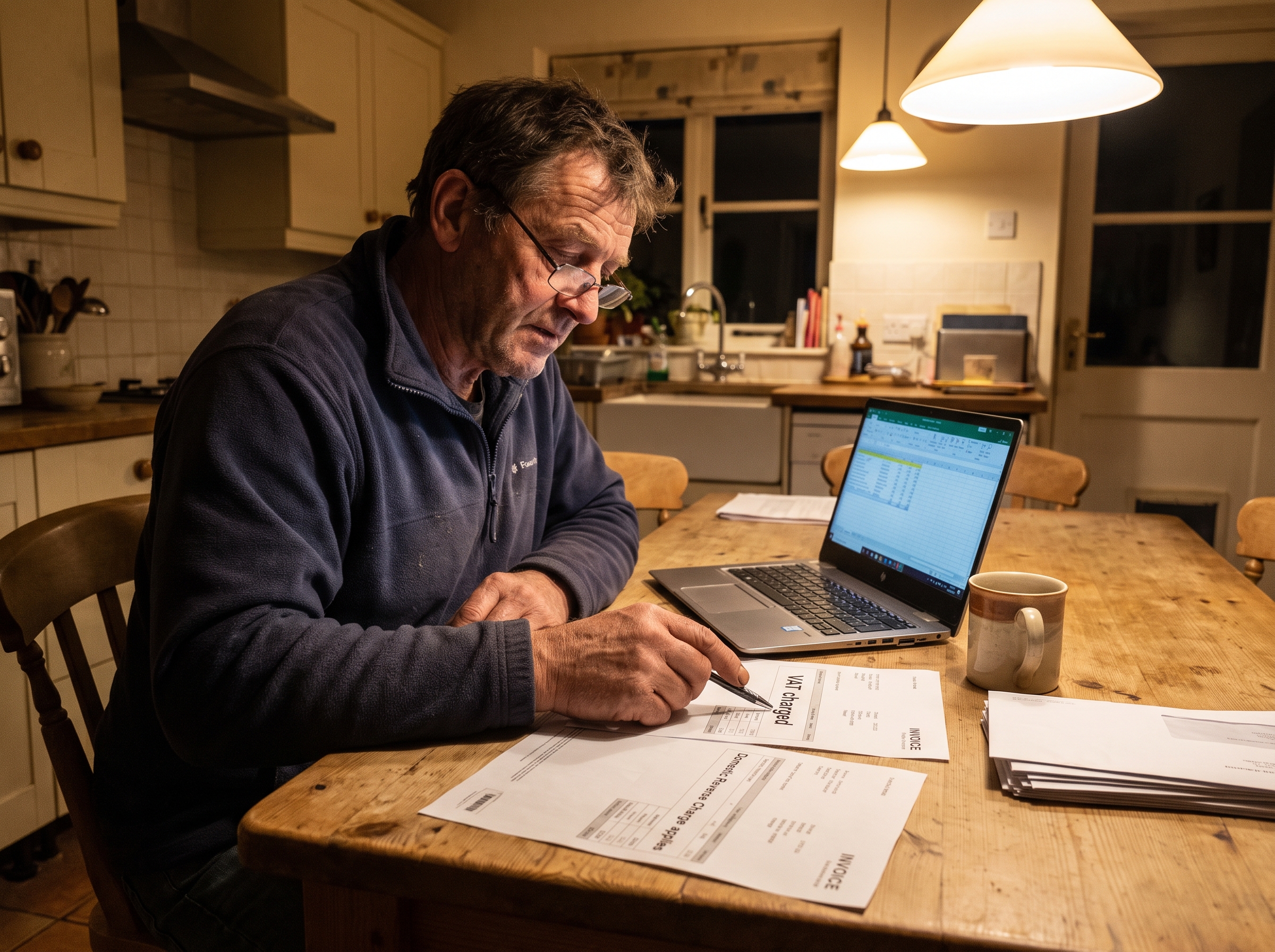
Domestic Reverse Charge · Construction VAT
Since March 2021, VAT on most construction services between VAT-registered businesses works differently. Instead of charging VAT and paying it to HMRC yourself, your customer accounts for it. Here's exactly when the reverse charge applies — and what happens when it doesn't.
The Domestic Reverse Charge for construction came into effect in March 2021 and it's still causing confusion. The core concept is simple: for most construction services supplied between VAT-registered businesses in the CIS chain, the customer — not the supplier — accounts for the VAT. But the conditions that determine whether it applies or not trip up even experienced subcontractors, particularly when the end customer is involved or when one party isn't VAT registered.
What the Domestic Reverse Charge Actually Does
Under normal VAT rules, if you're a VAT-registered subcontractor, you add VAT to your invoice, collect it from the customer, and pay it to HMRC on your next VAT return. The customer then reclaims it on their own return. Money changes hands twice — once when they pay you, once when they reclaim it from HMRC.
The Domestic Reverse Charge was introduced to tackle VAT fraud in construction supply chains, where some businesses were collecting VAT from customers and disappearing before paying it to HMRC. Under the reverse charge, VAT never passes through the subcontractor's hands at all. You invoice for your net amount, note that the reverse charge applies, and your customer accounts for the VAT directly on their own return — paying it to HMRC and reclaiming it in the same transaction.
The reverse charge doesn't change how much VAT is owed on a job. It changes who pays it to HMRC. The customer handles the VAT; you just need to make sure your invoice says so correctly.
CIS Tax Insights · 2026When the Reverse Charge Applies — and When It Doesn't
This is where most confusion arises. The reverse charge applies when all four of these conditions are met:
- The supply is of construction services within the scope of CIS
- Both you and your customer are VAT-registered
- Your customer is also in the CIS chain — not the end user/client
- The services are standard or reduced-rated for VAT (not zero-rated)
- You or your customer are not VAT-registered
- Your customer is the end user — the property owner using the building themselves
- The services are zero-rated (e.g. new residential builds)
- The supply is not within CIS scope (e.g. professional services, architecture)
If you're working directly for the person or business who will occupy or use the building — not for another contractor — normal VAT rules apply. The reverse charge only applies within the CIS supply chain, not at the end of it. A homeowner having an extension built is an end user. A housing developer having units built to sell is also an end user. A main contractor who is building on behalf of a developer is not — the reverse charge applies to invoices going up that chain.
What to Put on Your Invoice
When the reverse charge applies, your invoice needs to show specific information so your customer knows they need to account for the VAT themselves. Here's what a correctly formatted reverse charge invoice looks like.
The key elements are: your VAT registration number, the VAT rate that would apply, the amount of VAT the customer needs to account for (even though you're not charging it), and a clear statement that the domestic reverse charge applies. Without this wording, your customer may not process the VAT correctly — which creates a problem for both of you.
Both errors create VAT liability. If you charge VAT on a reverse charge supply, your customer shouldn't pay it — and if they do, they can't reclaim it in the normal way, creating a cash flow problem. If you fail to apply the reverse charge and charge VAT normally, you'll collect VAT that should have stayed with your customer — and you'll owe it to HMRC even if your customer disputes the invoice. Getting the classification right matters in both directions.
How the Reverse Charge Affects Your Cash Flow
The most significant practical effect of the Domestic Reverse Charge for most subcontractors is cash flow. Under normal VAT rules, if you raise a £10,000 invoice with £2,000 VAT, you receive £12,000 and hold £2,000 until your next VAT return. That £2,000 is effectively interest-free working capital for up to three months.
Under the reverse charge, you receive £10,000 and the customer handles the £2,000 directly. You never have that float. This is particularly noticeable if you moved from normal VAT to the reverse charge — the first quarter after the change, your VAT return may show a repayment rather than a payment, as your input VAT exceeds the output VAT you're now collecting.
| Item | Standard VAT | Reverse Charge |
|---|---|---|
| Amount invoiced | £10,000 + £2,000 VAT = £12,000 | £10,000 (no VAT charged) |
| Amount received | £12,000 | £10,000 |
| VAT you pay to HMRC | £2,000 (on your next return) | £0 (customer pays directly) |
| Net position for you | £10,000 after VAT paid | £10,000 immediately |
| Working capital float | +£2,000 for up to 90 days | None |
Even though you're not charging output VAT on reverse charge supplies, you can still reclaim VAT on your own purchases — materials, tools, equipment, van running costs. If your input VAT exceeds your output VAT in a quarter (which is common for subcontractors under the reverse charge), HMRC owes you a refund. Make sure you're completing your VAT returns accurately so these repayments are claimed promptly.
Frequently Asked Questions
I'm not VAT-registered. Does the Domestic Reverse Charge affect me?
No — if you're below the VAT registration threshold (currently £90,000 for 2026/27) and not voluntarily registered, the reverse charge doesn't apply to your invoices. You don't charge VAT and you don't need to reference the reverse charge. However, if you're approaching the threshold, it's worth registering and understanding the reverse charge before your first VAT return rather than after.
My customer says they're an end user. How do I confirm this?
You can ask your customer to confirm in writing that they're the end user for VAT purposes — meaning they intend to occupy or use the building themselves rather than selling on or further developing it. HMRC accepts written confirmation from the customer as protection for the subcontractor, provided you didn't have reason to believe the confirmation was false. Keep the confirmation on file with the relevant invoices.
Does the reverse charge apply to materials as well as labour?
Yes — when the reverse charge applies to a supply, it applies to the whole invoice, including both labour and materials. You can't split an invoice between reverse charge labour and standard-rated materials. If the reverse charge conditions are met, the entire supply falls under it. The exception is if you're supplying materials only, with no construction labour — in that case, the reverse charge doesn't apply and standard VAT rules do.
What if I get it wrong and charge VAT when I shouldn't have?
If you incorrectly charge VAT on a reverse charge supply, you still owe that VAT to HMRC — even if your customer refuses to pay it. The correct approach is to issue a corrected invoice removing the VAT charge, and if the VAT has already been paid, adjust it on your next VAT return. If you've already paid the VAT to HMRC and your customer has paid the incorrectly charged VAT to you, you can correct this through your VAT returns. Your accountant can help with the specific mechanics of the correction.
People Also Ask
Do I charge VAT on construction invoices to another contractor?
If both you and your customer are VAT-registered and your customer is in the CIS supply chain — not the end user — you apply the Domestic Reverse Charge. This means you do not charge VAT on your invoice. Instead, you note that the reverse charge applies and your customer accounts for the VAT directly to HMRC. Normal VAT rules apply if either party is not VAT-registered or if your customer is the end user.
When does the Domestic Reverse Charge not apply to construction?
The Domestic Reverse Charge does not apply when: either you or your customer are not VAT-registered; your customer is the end user (a business or homeowner using the building themselves); the services are zero-rated such as new residential construction; or the supply is outside the scope of CIS such as professional services or architecture.
What do I write on an invoice when the Domestic Reverse Charge applies?
Your invoice should show your VAT registration number, the net amount, the VAT rate that would apply (e.g. 20%), the amount of VAT the customer needs to account for, and the statement: "Domestic Reverse Charge — Customer to account for VAT of [amount] to HMRC under the domestic reverse charge at 20%." Without this wording, your customer may not process the VAT correctly.
What is the VAT registration threshold for construction workers in 2026/27?
The VAT registration threshold for 2026/27 is £90,000 of taxable turnover in any rolling 12-month period. If your gross CIS earnings are below this threshold and you are not voluntarily registered, the Domestic Reverse Charge does not apply to your invoices and normal VAT rules (including no VAT charged) apply to your supplies.
One Rule, Two Situations — Know Which Applies
The Domestic Reverse Charge is simpler in practice than it appears on paper. Most subcontractors working within the CIS chain — invoicing a main contractor or another subcontractor above them — will apply it to most of their VAT-registered supplies. Subcontractors working directly for end users — homeowners, businesses using the building themselves — use normal VAT rules.
The key habits are straightforward: confirm whether your customer is an end user or in the CIS chain, make sure your VAT number appears on every invoice, include the correct reverse charge wording when it applies, and claim your input VAT consistently so any repayments come back promptly. When in doubt, your accountant can confirm the correct treatment for a specific job before you raise the invoice — that's a much simpler conversation than correcting a mistake after the fact.
📖 HMRC Guidance Referenced in This Article
- HMRC — VAT Domestic Reverse Charge for Building and Construction Services Official HMRC guidance on when and how the reverse charge applies
- HMRC Notice 735 — Construction Industry Scheme: reverse charge Detailed technical guidance including the end user definition and invoice requirements
- HMRC — VAT Registration Threshold Current VAT registration threshold and how to register
QuoteDone Tools
Get Your CIS Invoices Right Every Time.
Check your CIS refund position and generate compliant invoices — whether you're working under standard VAT, the domestic reverse charge, or both.
This article is for informational purposes only and does not constitute formal VAT, accounting, or legal advice. The Domestic Reverse Charge rules and VAT registration threshold are subject to change. Always confirm the correct VAT treatment for specific supplies with a qualified accountant or VAT adviser. Aligned to 2026/27 HMRC guidance.